
Run this in AIHR BD instead of a spreadsheet
NBR-compliant payroll, ZKTeco & Hikvision attendance sync and bKash/Nagad salary disbursement — 14-day free trial, no credit card required.
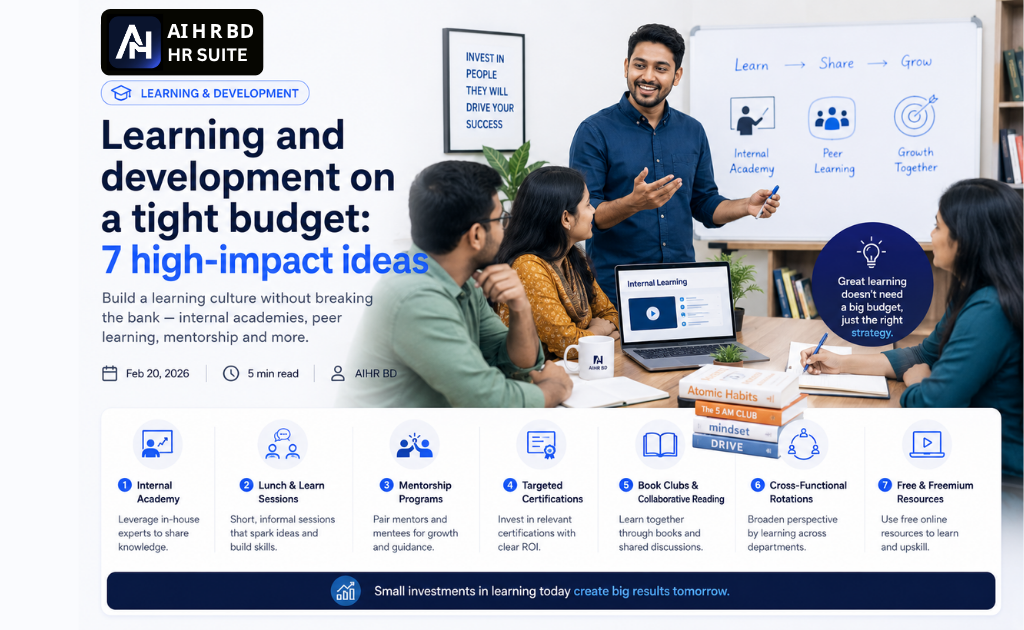
Investing in employee learning and development (L&D) is crucial for growth, but often seems out of reach for companies with limited budgets. The good news is you don't need expensive platforms or external consultants to foster a vibrant learning culture. Strategic, low-cost initiatives can yield significant results.
Key takeaways
- Leverage internal expertise through expert-led sessions and knowledge sharing.
- Foster peer-to-peer learning and mentorship programs to build skills and relationships.
- Prioritize targeted certifications over generic courses for measurable ROI.
- Create opportunities for cross-functional learning to broaden perspectives.
- Even small investments in resources like books or conference attendance can yield high returns.
Why low-cost L&D matters
In today's fast-paced business environment, continuous learning is not a luxury—it's a necessity. For many Bangladeshi SMEs, traditional L&D solutions with hefty price tags from international providers are simply not feasible. However, this doesn't mean compromising on employee development. By focusing on internal resources and creative strategies, companies can build highly effective learning programs that drive engagement, improve performance, and retain talent without breaking the bank.
1. Build an internal academy with existing talent
Your organization already possesses a wealth of knowledge within its ranks. Tap into this by creating an "internal academy." Identify your top 3-5 subject matter experts across different departments. Ask each expert to prepare and record one 30-minute session per quarter on a topic they excel in.
Example topics: "Advanced Excel for HR professionals," "Mastering client presentations," "Introduction to digital marketing analytics," or "Best practices for inventory management."
These sessions can be recorded using simple tools like Zoom or Google Meet, requiring no specialized software. Store these recordings in a private library on platforms like YouTube (using unlisted links) or Google Drive, making them accessible to your entire team on demand. This approach not only provides valuable training but also recognizes and empowers your internal experts.
2. Implement "Lunch and Learn" sessions
A classic yet highly effective L&D strategy, "Lunch and Learn" sessions are easy to implement and incredibly cost-efficient. Dedicate one day a week or bi-weekly, perhaps a Friday, for a team member to present on a topic of their choice. This could be a new skill they've acquired, insights from an industry article, or even a personal hobby relevant to professional development.
The company can provide a simple incentive like pizza or light refreshments to encourage participation. These sessions foster a culture of shared learning, improve presentation skills, and expose employees to diverse perspectives. It’s a low-pressure environment where everyone can contribute and learn.
3. Establish a structured mentorship program
Mentorship programs are invaluable for both junior and senior employees, costing virtually nothing beyond the participants' time. Pair less experienced team members with seasoned professionals for regular one-on-one meetings, perhaps monthly.
Key benefits:
- Skill transfer: Mentees gain practical skills and industry insights.
- Career guidance: Mentors help navigate career paths and challenges.
- Leadership development: Mentors hone their coaching and leadership abilities.
- Enhanced retention: Strong mentorship bonds increase job satisfaction and loyalty.
To track progress and ensure accountability, integrate mentorship goals into your existing HRM Software in 2026: A Buyer's Guide for Bangladeshi Companies if it has a performance management or goal-setting module. This helps document achievements and identify areas for improvement.
4. Strategic allocation for conferences and certifications
While sending an entire team to a large conference might be costly, strategically investing in a single ticket for a key individual can yield significant returns. Choose a relevant local industry summit or workshop. The selected employee attends, gathers information, and then shares their learnings with the broader team through a presentation or internal memo.
For certifications, prioritize those with clear, measurable ROI. Instead of generic online courses, focus on industry-recognized certifications in areas like:
- Cloud platforms: AWS, Azure, Google Cloud
- Cybersecurity: CompTIA Security+, CEH
- Project management: PMP, PRINCE2
- Specific software: Salesforce Admin, SAP modules
These certifications validate expertise and directly contribute to business capabilities. Often, the cost of a certification exam is far less than a full university course, and it provides a tangible, marketable skill.
5. Foster learning through book clubs and collaborative reading
A company book club is a simple yet powerful way to encourage continuous learning. Select a relevant business book each quarter—perhaps focusing on leadership, innovation, specific industry trends, or even AI in HR: Top Trends Shaping the Future of Work in 2026. Purchase 5-10 copies and rotate them among interested team members.
Organize a monthly or bi-weekly discussion session to delve into the book's themes, share insights, and discuss how the concepts apply to your organization. This builds critical thinking, encourages active reading, and stimulates intellectual conversation among employees.
6. Implement cross-functional rotations
Breaking down departmental silos can lead to profound learning experiences. Arrange short-term cross-functional rotations where employees spend time in a different department. For instance, a finance analyst could spend a month working closely with the sales team, or a marketing specialist could shadow the customer support department.
Benefits of cross-functional rotations:
- Increased empathy: Employees gain a deeper understanding of other roles and challenges.
- Broader skill sets: Exposure to new functions develops versatile skills.
- Improved collaboration: Enhanced understanding leads to better teamwork.
- Problem-solving: Diverse perspectives can uncover innovative solutions.
This initiative costs nothing beyond internal coordination and can significantly improve overall organizational effectiveness.
7. Leverage free and freemium online resources
The internet is a treasure trove of free educational content. Platforms like Coursera, edX, and Khan Academy offer free audit options for many courses. YouTube is filled with excellent tutorials on almost any software or skill. Encourage employees to explore these resources, and perhaps even dedicate specific time slots for self-paced learning.
Consider these platforms for targeted learning:
| Platform | Focus Areas | Cost Model | Notes |
|---|---|---|---|
| Coursera/edX | Wide range of university-level courses | Freemium (audit free) | Certificates for a fee |
| YouTube | Tutorials, how-tos, expert talks | Free | User-generated content, quality varies |
| LinkedIn Learning | Business, creative, tech skills (often trial) | Subscription | Offers free trials |
| HubSpot Academy | Inbound marketing, sales, service | Free | Industry-recognized certifications available (free) |
| Google Skillshop | Google Ads, Analytics, Marketing Platform | Free | Official certifications for Google products |
By promoting a culture where employees are encouraged to seek out these resources, you empower them to take ownership of their development without incurring direct costs to the company. Sometimes, the best learning comes from self-direction and curiosity.
Related reading
Frequently asked questions
- How can my small business in Bangladesh afford staff training without a big budget?
- Bangladeshi SMEs can leverage internal expertise by creating an internal academy where knowledgeable employees lead short training sessions. Implementing lunch-and-learn sessions or structured mentorship programmes are also highly cost-effective ways to foster continuous learning and skill development within your team. These methods use existing resources, making L&D accessible for tight budgets.
- What kind of free or low-cost L&D programmes work best for Bangladeshi companies?
- Internal knowledge sharing through an internal academy with recorded sessions is a great starting point, using tools like unlisted YouTube videos or Google Drive. Lunch-and-learn sessions, where team members present on topics, require minimal investment. Additionally, establishing structured mentorship programmes uses existing staff to transfer skills and build leadership capacity at no direct cost.
- Can I use our existing HR software to manage mentorship or L&D tracking in Bangladesh?
- Yes, if your HRM software in Bangladesh includes performance management or goal-setting modules, you can integrate mentorship goals directly into it. This allows you to track mentees progress, document achievements, and ensure accountability within the programme. Utilising existing software helps manage L&D efforts without additional platform costs.
- What certifications should my employees in Bangladesh pursue for good ROI?
- For strong ROI, focus on industry-recognised certifications directly relevant to your business needs, rather than generic courses. Examples include certifications in cloud platforms (AWS, Azure), cybersecurity (CompTIA Security+), or project management (PMP, PRINCE2). These specific certifications validate expertise and provide tangible, marketable skills that directly contribute to business capabilities.