
Run this in AIHR BD instead of a spreadsheet
NBR-compliant payroll, ZKTeco & Hikvision attendance sync and bKash/Nagad salary disbursement — 14-day free trial, no credit card required.
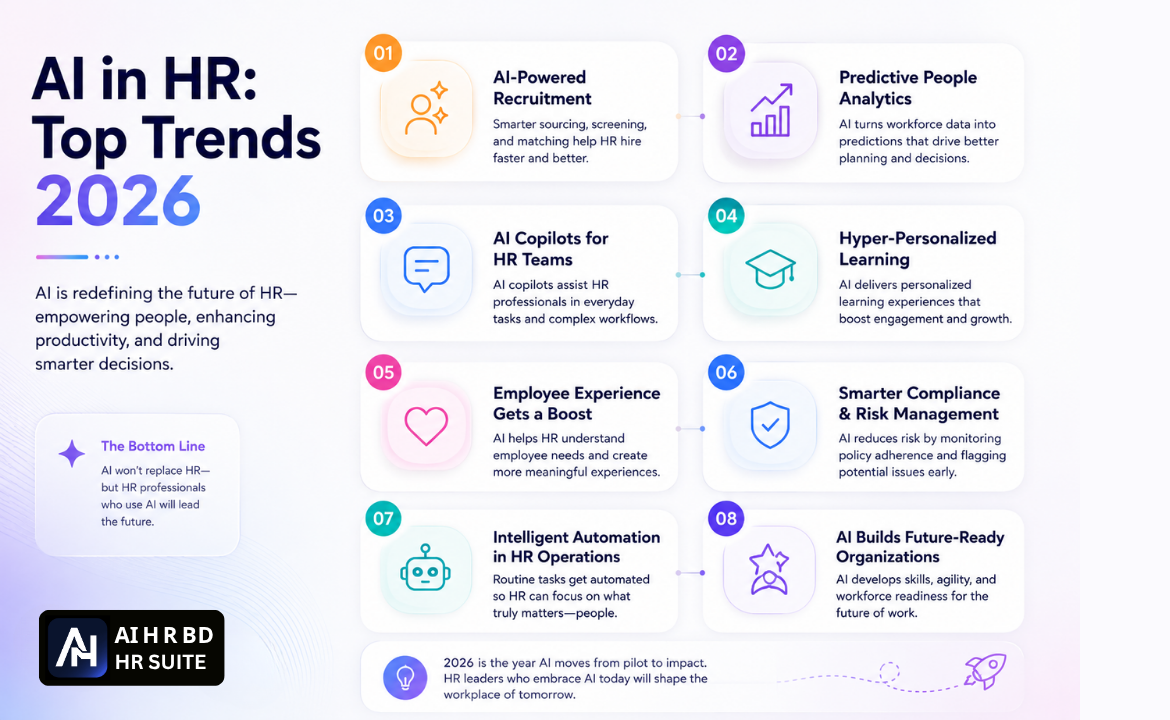
Artificial Intelligence is rapidly transitioning from a futuristic concept to an indispensable component of modern Human Resources. From recruitment and engagement to workforce planning and compliance, AI empowers HR teams in Bangladesh and globally to make faster, smarter, and more data-driven decisions. As digital transformation accelerates, HR leaders are discovering unprecedented opportunities to boost efficiency and elevate the employee experience.
Key takeaways:
- AI is revolutionizing recruitment by automating sourcing and screening, freeing HR for strategic talent engagement.
- Predictive analytics driven by AI provides invaluable insights into workforce trends, turnover, and future needs.
- AI copilots and intelligent automation are streamlining routine HR tasks like payroll, leaving, and attendance.
- Personalized learning, enhanced employee experience, and improved compliance are all being powered by AI.
- The future of HR involves a powerful synergy between human expertise and AI, not replacement.
AI-Powered Recruitment Becomes the Standard
Recruitment is one of the HR functions experiencing the most significant AI-driven transformation. Recruiters are increasingly leveraging AI to automate time-consuming tasks such as candidate sourcing from various platforms, initial resume screening based on specific keywords and criteria, and even scheduling interviews. This automation allows HR professionals to dedicate more time to critical activities like building candidate relationships, conducting deeper evaluations, and ultimately making more strategic hiring decisions.
Recruiters spend 60% of their time on administrative tasks. AI can reduce this significantly, allowing them to focus on high-value interactions.
AI-powered tools can analyze vast amounts of data to identify best-fit candidates, reduce unconscious bias, and create a more efficient hiring pipeline. This is particularly beneficial for companies in Bangladesh looking to scale quickly and acquire top talent.
Predictive People Analytics Drives Better Decisions
AI-powered analytics tools are moving beyond descriptive reporting to offer powerful predictive capabilities. These tools can analyze historical employee data to identify workforce trends, forecast potential employee turnover, and pinpoint skill gaps before they become critical. For HR leaders, this means anticipating workforce needs more effectively, optimizing resource allocation, and crafting proactive retention strategies. Imagine predicting which employees are likely to leave in the next six months and intervening with targeted development or engagement initiatives. Such insights are invaluable for strategic workforce planning and talent management.
AI Copilots Transform Everyday HR Operations
AI assistants, often referred to as "copilots," are becoming indispensable partners for HR professionals. These intelligent tools can handle a wide array of routine inquiries, generate standard reports, draft policy documents, and even assist with data entry. By offloading these repetitive tasks, AI copilots enable HR teams to operate more quickly and efficiently. For instance, an AI copilot could instantly answer an employee's question about leave balance or generate a detailed attendance report for compliance, freeing up HR staff for more complex problem-solving and strategic initiatives. Look for these functionalities in the best HR software in Bangladesh for growing companies.
Personalized Learning and Development
The era of one-size-fits-all training programs is fading. AI is ushering in highly personalized learning and development experiences. Modern AI-driven platforms can analyze an employee's current skills, career aspirations, and performance data to recommend tailored courses, learning paths, and skill development opportunities. This targeted approach ensures that employees receive relevant training, making learning more engaging and effective. For organizations, it translates to a more skilled and adaptable workforce, ready to meet future challenges.
Employee Experience Gets Smarter
AI is profoundly enhancing the employee experience by enabling organizations to understand and respond to employee needs with greater precision. AI tools can analyze sentiment from employee surveys, communication channels, and feedback platforms to identify engagement challenges, pinpoint areas for improvement, and anticipate employee dissatisfaction. This allows HR to proactively address issues and create more personalized workplace experiences. From dynamic feedback systems to AI-powered chatbots that resolve common queries quickly, smarter insights lead to happier, more productive teams and a reduction in employee churn.
Compliance and Risk Management Improve with AI
Navigating the complexities of labor laws, NBR tax regulations, and company policies is a continuous challenge for HR departments, especially in Bangladesh. AI tools are emerging as powerful allies in ensuring compliance and mitigating risk. They can continuously monitor policy adherence, identify deviations, and flag potential compliance issues such as incorrect Provident Fund calculations or gratuity disbursements. Furthermore, AI can help HR teams stay abreast of changing regulations, reducing legal exposure and strengthening overall corporate governance.
Intelligent Automation Reduces Administrative Work
Intelligent automation, often powered by AI, is revolutionizing the execution of routine HR tasks. Processes such as payroll processing, leave management, attendance tracking (integrating with systems like ZKTeco or Hikvision), and document handling are increasingly being automated.
Automation Impact on Key HR Functions
| HR Function | Traditional Approach | AI-Powered Automation | Benefits |
|---|---|---|---|
| Payroll | Manual calculations, bank transfers | Auto-calculation, direct deposits | Reduced errors, faster processing, compliance |
| Leave Management | Paper forms, manual tracking | Self-service portal, auto-approvals | Employee convenience, accurate records |
| Attendance | Manual registers, biometric data upload | Real-time sync, auto-reporting | Improved accuracy, time savings, compliance |
| Onboarding | Manual paperwork, multiple sign-offs | Digital forms, automated workflows | Faster integration, better compliance |
By automating these transactional activities, HR professionals are freed from administrative burdens, allowing them to focus on strategic initiatives that directly impact business growth and employee well-being. This is where HRM software in 2026: A buyer's guide for Bangladeshi companies will be crucial for selection.
Skills-Based Organizations Gain Momentum
The traditional focus on job titles and degrees is evolving. Companies are increasingly adopting a skills-based approach, leveraging AI to identify, track, and develop specific skills within their workforce. AI can analyze resumes, project histories, and performance data to map existing skills, identify skill gaps, and match employees to new opportunities internally. This approach not only improves internal mobility and workforce agility but also fosters a culture of continuous learning and development, ensuring the organization remains competitive in a rapidly changing market.
The Future of HR Is Human + AI
It's crucial to understand that AI is not here to replace HR professionals. Instead, it serves as a powerful enhancer, empowering them with superior insights, streamlined processes, and amplified strategic capabilities. Organizations that successfully integrate human expertise with AI-driven intelligence will be uniquely positioned to attract, retain, and develop top talent in the coming years.
As we move through 2026, HR leaders who embrace AI responsibly and strategically will play a pivotal role in shaping a more efficient, engaging, and innovative future of work for Bangladesh's growing workforce.
Related reading:
Frequently asked questions
- How can AI recruitment tools help my company hire better in Bangladesh?
- AI tools automate sourcing, CV screening, and interview scheduling so your HR team can focus on deeper candidate evaluation. This helps identify best-fit candidates faster, reduce unconscious bias, and build a more efficient hiring pipeline as you scale.
- Will AI copilots work with the HR software commonly used in Bangladesh?
- Yes. AI copilots handle routine tasks such as answering leave balance queries, generating attendance reports, and supporting payroll processing. They integrate with existing systems, including attendance captured by ZKTeco or Hikvision devices.
- How can AI help my HR department stay compliant with the Labour Act 2006 and NBR rules?
- AI tools can monitor policy adherence and flag potential issues such as incorrect Provident Fund calculations or gratuity disbursements. They also help HR teams keep pace with changing NBR tax regulations, reducing legal exposure.
- What is predictive analytics in HR and how does it benefit a Bangladeshi business?
- Predictive analytics uses historical employee data to spot workforce trends and forecast turnover or skill gaps. For local businesses this means anticipating hiring needs earlier, allocating resources better, and building proactive retention strategies.