
Run this in AIHR BD instead of a spreadsheet
NBR-compliant payroll, ZKTeco & Hikvision attendance sync and bKash/Nagad salary disbursement — 14-day free trial, no credit card required.
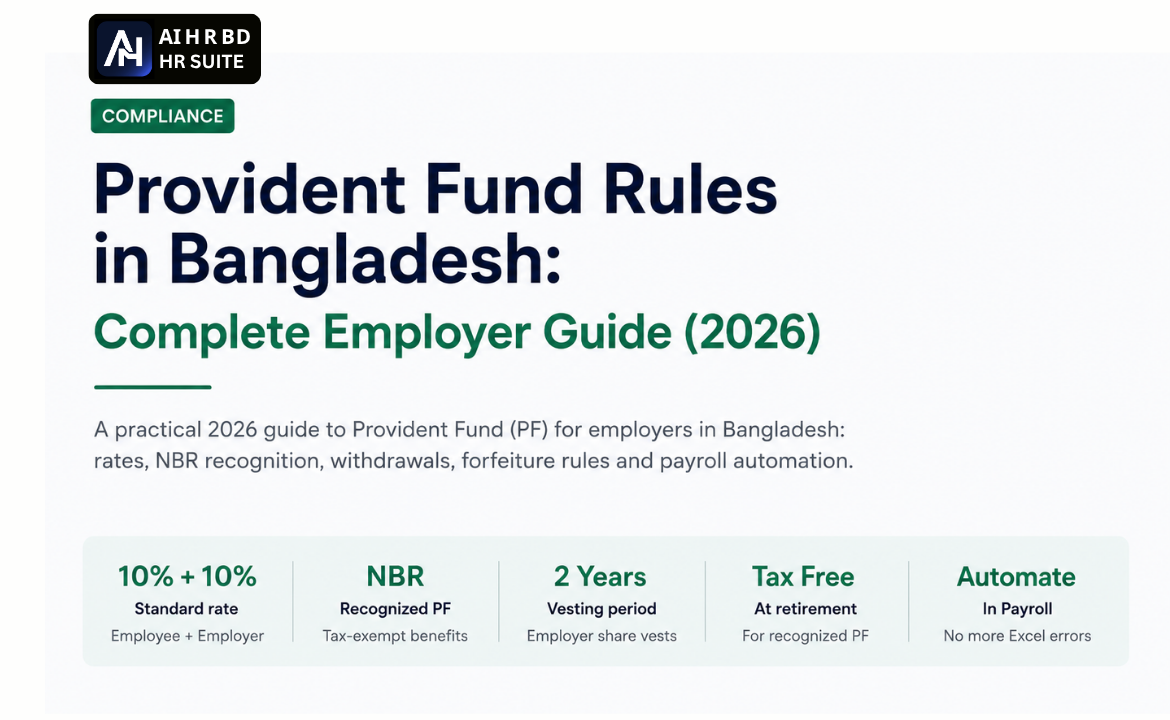
Provident Fund (PF) is one of the most asked-about benefits in Bangladeshi HR — and one of the most mis-handled. Employees expect it, the Labour Act 2006 governs it, and the NBR decides whether contributions are tax-free. Get the setup wrong and you create silent payroll liabilities for years.
This guide walks through the rules that actually matter in 2026, with concrete BDT examples and a checklist you can ship to your HR and finance team this week.
Key takeaways
- PF is not mandatory for private employers under the Labour Act 2006 — but once you constitute a fund, contributions become a contractual obligation.
- Standard market rate: 10% of basic salary from employee, matched 10% from employer. Some groups go 8%/8%.
- A recognized PF under NBR's Sixth Schedule gets full tax exemption on employer contributions and accrued interest (within limits). An unrecognized PF is taxed as salary.
- Employees who resign before completing 2 years typically forfeit the employer share — the trust deed decides.
- Manual PF tracking breaks at ~50 employees. Automate it inside payroll, not in a separate spreadsheet.
What the Labour Act actually says
Section 264 of the Bangladesh Labour Act 2006 makes a Provident Fund mandatory only for workers in private-sector establishments where the majority demand it, and for some state-linked sectors (tea, jute, railway). For everyone else, PF is voluntary — but very common, because it is the cheapest retention tool you have.
Once you constitute a fund through a registered trust deed, the rules of that deed bind you. That deed must specify:
- Contribution rate (employer and employee)
- Vesting period (usually 2 years before employer share vests)
- Withdrawal triggers (resignation, retirement, death, medical, housing)
- Interest credit policy
Common mistake: Companies promise "10% PF" in offer letters without ever registering a trust. That is an unrecognized fund — taxable, and legally messy.
Recognized vs unrecognized PF (the NBR view)
| Item | Recognized PF | Unrecognized PF |
|---|---|---|
| Employer contribution | Tax-exempt for employee | Added to taxable salary |
| Interest credited | Exempt up to NBR ceiling | Fully taxable |
| Withdrawal at retirement | Tax-free | Taxable as salary |
| Approval needed | NBR Commissioner of Taxes | None |
For groups of industries and any company above ~100 employees, registering the fund with NBR is worth the paperwork. The annual tax saving for a mid-level employee easily exceeds ৳20,000.
A worked BDT example
Employee basic salary: ৳40,000/month. PF rate: 10% + 10%.
- Employee contribution: ৳4,000 (deducted from gross)
- Employer contribution: ৳4,000 (paid by company into PF trust)
- Monthly PF inflow per employee: ৳8,000
- Annual: ৳96,000 + declared interest (typically 7–9%)
After 10 years at this salary, the corpus crosses ৳12 lakh before interest — a real number employees compare across employers.
Vesting, forfeiture, and final settlement
The trust deed sets the vesting rule. Market-standard:
- <2 years of service: employee gets back only their own contribution + interest. Employer share is forfeited to the fund.
- 2–5 years: 50% of employer share vests.
- >5 years: 100% vests.
On death or permanent disability, full vesting applies immediately — make sure your deed says so explicitly.
How to run PF in payroll without spreadsheets
This is where most Bangladeshi SMEs lose hours every month. A clean PF flow looks like:
- PF eligibility flag on the employee record (after probation, usually 6 months).
- PF rate (%) stored against the salary structure, not hard-coded per payslip.
- Employee deduction shown on the salary sheet as a separate line.
- Employer contribution posted to a PF Payable ledger, not to salary expense.
- Monthly transfer to the PF trust bank account on the same day as salary disbursement.
- Annual PF statement issued to every employee by 31 July.
If you are still doing this in Excel, your reconciliation between the salary register and the PF trust will drift. A modern HRMS handles all six steps as a single payroll run — see our buyer's guide to HRM software for what to look for.
Withdrawal and loan rules
The Labour Act allows partial PF withdrawal for:
- House construction or purchase
- Marriage of self or children
- Medical treatment of self or dependent
- Higher education
Most trust deeds cap loans at 75% of the employee's own contribution and require repayment via salary deduction over 24–36 months. Document every loan — DIFE inspectors will ask.
Compliance checklist for 2026
- Trust deed registered and signed by ≥3 trustees
- NBR recognition certificate on file
- Separate PF bank account (not the company operating account)
- Monthly contribution reconciled within 5 working days of salary
- Annual audited PF accounts filed
- Employee nomination forms collected and updated yearly
Treat this like your Labour Law compliance program — quarterly internal audit, no surprises during a DIFE visit.
Related reading
Frequently asked questions
- Is Provident Fund mandatory in Bangladesh?
- Under Section 264 of the Bangladesh Labour Act 2006, PF is mandatory only for certain regulated sectors (tea, jute, railway) and for private establishments where the majority of workers demand it. For most private employers it is voluntary — but once you constitute a fund via a registered trust deed, contributions become a binding contractual obligation.
- What is the standard PF contribution rate in Bangladesh?
- The market-standard rate is 10% of basic salary from the employee, matched by 10% from the employer. Some group-of-industries set it at 8% + 8% to manage cost. The exact rate must be specified in the trust deed and the employment contract.
- Are PF contributions tax-free in Bangladesh?
- Only contributions to a Recognized Provident Fund (approved by the NBR Commissioner of Taxes under the Sixth Schedule) are tax-exempt for the employee — employer share and accrued interest are exempt within ceilings. An unrecognized PF is treated as taxable salary.
- What happens to the employer PF share if an employee resigns early?
- Most trust deeds set a 2-year vesting period. If the employee resigns before completing the vesting period, the employer share is typically forfeited and goes back into the trust. The employee always keeps 100% of their own contributions plus interest.