
Run this in AIHR BD instead of a spreadsheet
NBR-compliant payroll, ZKTeco & Hikvision attendance sync and bKash/Nagad salary disbursement — 14-day free trial, no credit card required.
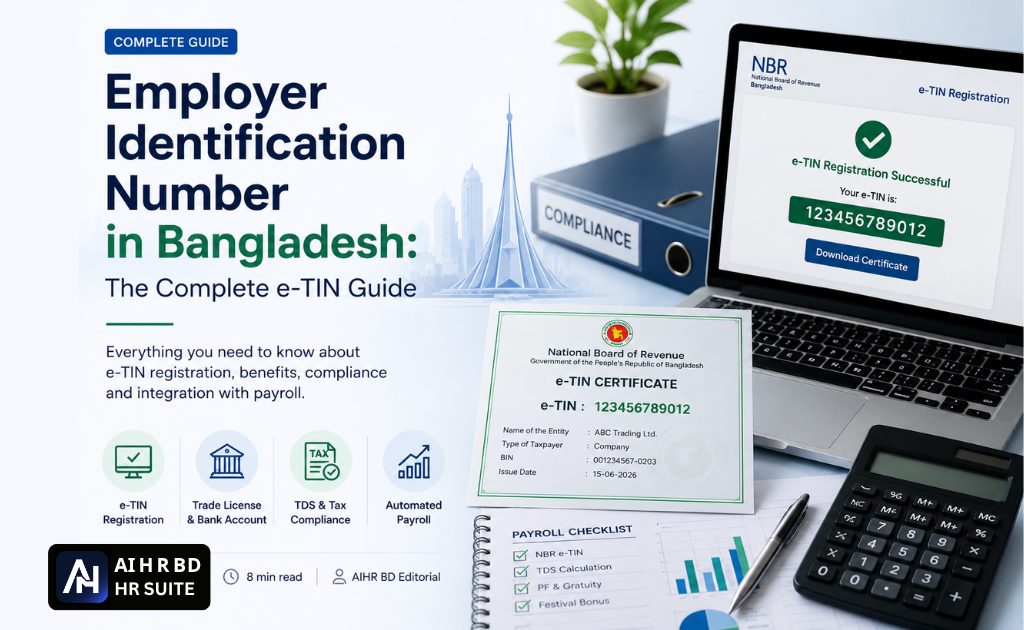
The Reality of the Employer Identification Number in Bangladesh
Businesses operating in Bangladesh face a common source of confusion: the term "employer identification number" belongs to US tax law, but the underlying need — a government-issued tax identity for your business — is just as real and urgent here.
In Bangladesh, that identifier is the 12-digit e-TIN (Electronic Taxpayer Identification Number), issued and managed by the National Board of Revenue (NBR). It is the single most important number your business will carry, functioning as the primary reference point for every tax obligation, filing, and compliance check the government runs against your entity.
Knowing how to get an employer identification number equivalent in Bangladesh means understanding what the e-TIN actually unlocks. It is a hard prerequisite for obtaining your Trade License from the City Corporation or municipal authority — without it, local government offices will not process your application. Corporate bank accounts follow the same rule: virtually every commercial bank in Bangladesh requires a valid e-TIN before opening a business account. According to the National Board of Revenue (NBR) Bangladesh, 100% of companies operating in the country must obtain an e-TIN to do business legally and file annual returns.
The stakes are straightforward — no e-TIN means no license, no bank account, and no legal standing. The good news is that the NBR's online portal has made the registration process faster than ever, and the next section walks through exactly how to complete it.
Step-by-Step: How to Obtain Your e-TIN via the NBR Portal
Registering for an e-TIN in Bangladesh is a straightforward online process — but only if you arrive prepared with the right documents and understand which registration path applies to your business type.
Many business owners searching for guidance on how to get an EIN number quickly discover that Bangladesh operates its own distinct system. Under the Income Tax Act 2023, every company and partnership firm must register for an e-TIN before commencing operations — making this one of the first administrative tasks on your launch checklist.
The registration process breaks down into five clear steps:
- Visit the official portal. Navigate to etaxnbr.gov.bd, the NBR's dedicated e-tax service platform.
- Select your taxpayer type. Choose between "Individual" (for sole traders and proprietors) or "Company/Firm" (for incorporated entities and partnerships). This distinction affects which fields and documents are required.
- Gather your documentation. Individual applicants need a valid National ID (NID). Company registrations additionally require your Incorporation Number from the Registrar of Joint Stock Companies (RJSC) and a Trade License where available.
- Complete the online form. Enter your business details, registered address, and tax circle information accurately.
- Submit and retrieve your certificate. A 12-digit e-TIN is issued digitally upon successful verification — no physical office visit required.
Pro-Tip — NID Verification: Your National ID number must exactly match the Election Commission database. Even a single digit error will cause your application to fail at the verification stage. Double-check your NID card before you begin, and ensure the name spelling is consistent across all submitted documents.
Individual vs. company registration is a distinction worth emphasizing. A sole proprietor registers under their personal NID and receives a TIN linked to their individual taxpayer profile. A limited company, however, registers as a separate legal entity — meaning the business holds its own TIN independently of the founder's personal tax record. Getting this classification right from the start avoids compliance headaches down the road.
Once your e-TIN is secured, it unlocks a range of critical business functions — and payroll management is one of the most immediately impactful.
Why Your Tax ID is the Key to Automated Payroll
A completed NBR e-TIN registration in Bangladesh doesn't just satisfy a legal checkbox — it becomes the operational backbone of every payroll, payment, and compliance workflow your business runs.
Without a verified e-TIN, automated payroll simply cannot function legally in Bangladesh.
The most immediate connection is Tax Deducted at Source (TDS). When your business pays employee salaries, the Income Tax Ordinance requires you to withhold and remit tax on behalf of eligible employees. That deduction is only legally defensible when it's tied to a validated tax identity. As the Bangladesh Investment Development Authority (BIDA) confirms, a valid tax certificate is required to verify the legal identity of the business entity for processing BDT payroll — meaning payroll processors and banks expect to see it before transactions clear.
Integration with digital payment infrastructure is equally dependent on your tax ID. Gateways like bKash and Nagad require business accounts to be linked to verified tax credentials before disbursing payroll at scale. Merchants operating without this linkage face transaction limits and account holds that can stall an entire pay cycle.
For growing SMEs, the risk compounds quickly. Manual tax tracking — spreadsheets, paper ledgers, ad hoc calculations — might work at five employees, but it breaks down at fifty. Errors in TDS calculations create mismatches between what you've withheld and what the NBR expects, triggering audit flags.
Integration benefits of a verified e-TIN include:
- Legal authorization to deduct and remit TDS from employee salaries
- Eligibility for merchant accounts on bKash, Nagad, and other MFS platforms
- Compatibility with cloud-based payroll and accounting software
- Cleaner audit trails that satisfy NBR record-keeping requirements
- Faster Trade License renewals tied to active tax compliance status
That last point — Trade License renewal — is where the stakes get serious for businesses that delay getting compliant, and it's worth understanding exactly what non-compliance costs.
The High Cost of Non-Compliance and Missing Identifiers
Ignoring e-TIN obligations doesn't just create paperwork headaches — it exposes your business to financial penalties, audit risk, and operational shutdowns that compound quickly.
Non-compliance with Bangladesh's tax identification requirements carries real, quantifiable costs that no business can afford to dismiss.
Under the Income Tax Act 2023, failure to file tax returns using a valid identification number triggers a penalty of 10% of the last assessed tax, with a minimum floor of 5,000 BDT. For a growing business, that baseline can escalate sharply — and repeat violations attract compounding scrutiny from the NBR.
⚠️ Penalty Warning: Failing to file returns with a valid TIN results in a fine of 10% of last assessed tax or a minimum of 5,000 BDT, whichever is greater. (Income Tax Act 2023, Government of Bangladesh)
Beyond direct fines, mismatched payroll data creates a separate layer of risk. When employee TINs submitted in payroll records don't align with NBR databases, those discrepancies act as automatic audit triggers. Much like how the employer identification number internal revenue service framework in the US flags inconsistencies across tax filings, Bangladesh's NBR cross-references TIN data against submitted returns — making accuracy non-negotiable.
Operationally, the consequences extend further. Without a valid e-TIN, businesses cannot renew their Trade License — effectively stalling core business operations. Import permits, bank financing, and government contract eligibility all face similar blockages.
Once you've secured your own e-TIN, the next practical question becomes locating your employer's tax identifier — which is where knowing exactly where to look saves considerable time.
How Do I Find My Employer's EIN Number?
Knowing how to obtain an EIN number — or its Bangladesh equivalent, the 12-digit e-TIN — is a practical necessity for every employee completing an annual tax return.
Pay stubs and prior returns are your first stop. Most companies print their tax identification number directly on salary slips, official offer letters, or annual tax certificates issued to staff. If you've filed a personal return before, your previous submission likely shows the employer's TIN in the withholding section. These documents are the fastest path to the number you need.
The Trade License and NBR's verification tool provide a reliable backup. A company's Trade License — publicly issued by the relevant City Corporation — displays the business registration details that connect to its TIN. From there, the NBR's TIN Verify portal allows anyone to confirm whether a given 12-digit number is active and valid. This is a critical step: as The Daily Star notes, the integration of automated tax filing systems is essential for SMEs to remain compliant with the NBR's evolving digital tax administration — and that compliance starts with verifiable, accurate identifiers.
HR departments carry a direct responsibility here. Under Bangladesh tax law, employers must withhold TDS on employee salaries and issue tax certificates accordingly. That means your HR or payroll team is legally obligated to provide the company's e-TIN upon request. If they're using an automated HRMS, this information is typically accessible through the employee self-service portal.
With the key sources for locating a tax ID now clear, the next step is putting everything together into an actionable compliance framework.
The Bottom Line: Your Compliance Checklist
Bangladesh business tax registration isn't optional — it's the foundation every compliant, bankable, and operational company in Bangladesh must build on from day one.
Getting your e-TIN in place quickly matters more than most new founders realize. Banks and local city corporations require a valid tax certificate to verify the legal identity of a business entity, according to BIDA, which means delays in registration can stall your ability to open a corporate account or secure your Trade License — two dependencies that affect almost every other business function downstream.
Here's a practical compliance sequence to keep your business on solid footing:
- Register immediately upon incorporation. Don't wait until your first payroll cycle or your first vendor contract. The e-TIN application through the NBR portal is free and can be completed digitally — there's no reason to defer it.
- Link your e-TIN to your corporate bank account and Trade License. An unlinked TIN is a compliance gap. Both your bank and the city corporation will reference your tax ID during verification, so ensure the records are consistent and current.
- Sync your tax ID with an automated HRMS. Manual TDS calculations invite errors. Connecting your e-TIN to a payroll system ensures NBR-compliant deductions are applied accurately each month.
- Verify your company's status annually. A lapsed or unverified TIN triggers a minimum penalty of 5,000 BDT — an avoidable cost that compounds quickly if overlooked year after year.
A valid, well-maintained e-TIN isn't just a regulatory checkbox — it's the data anchor that makes accurate, automated payroll possible. That connection between your tax identity and your HR operations is exactly where modern HRMS platforms deliver their greatest value.
Future-Proofing Your HR with AIHR BD
NBR compliance isn't a one-time checkbox — it's an ongoing operational discipline that demands the right infrastructure from day one.
Managing your e-TIN obligations manually leaves room for costly errors: miscalculated withholding tax, delayed filings, and disbursements that don't align with NBR reporting. In practice, the businesses that stay consistently compliant are those that embed tax logic directly into their HR and payroll systems rather than bolting it on at year-end.
AIHR BD automates NBR-ready BDT payroll by mapping your e-TIN data directly into salary calculations, tax deductions, and statutory reporting. Instead of cross-referencing spreadsheets against NBR brackets, your payroll runs with the correct withholding tax applied automatically — every cycle, every employee. That precision compounds over time, reducing audit risk and keeping your books clean.
The platform also integrates biometric attendance hardware — including ZKTeco and Hikvision devices — to ensure that the hours feeding your payroll are accurate before tax calculations even begin. Inflated attendance data is one of the most common sources of payroll tax discrepancies; eliminating it at the source protects both the employer and the employee on record.
Finally, native bKash and Nagad integration means disbursements are executed through channels NBR recognizes, with a traceable digital trail that supports compliant reporting. Every payment is linked, logged, and audit-ready.
If your Bangladesh business is ready to move from manual compliance patchwork to a system built for NBR from the ground up, book a demo with AIHR BD and see NBR-compliant payroll automation in action.
Related reading:
Frequently asked questions
- Who needs an e-TIN in Bangladesh?
- Under the Income Tax Ordinance, e-TIN is mandatory for: anyone with taxable income, all directors and shareholders of companies, all owners of motor vehicles, applicants for trade licences in city corporations, importers/exporters, members of professional bodies, and anyone executing land/flat documents valued at BDT 10 lakh or more.
- How long does it take to get an e-TIN in Bangladesh?
- The online application on the NBR portal (etaxnbr.gov.bd) is instant — most applicants receive the 12-digit e-TIN and certificate by email within 5–10 minutes if all NID and address details are correct. There is no government fee.
- Is an Employer Identification Number the same as e-TIN in Bangladesh?
- There is no separate Employer Identification Number in Bangladesh. The companys e-TIN is used as the employer identifier for all tax filings, payroll deductions, VAT registration and bank operations. Employees also need their personal e-TIN to be deducted at the correct slab.
- What documents do I need to apply for a company e-TIN?
- You need: certificate of incorporation, memorandum and articles of association, trade licence, NID of directors, lease agreement or ownership document for the registered office, and a board resolution authorising the signatory. Upload them as PDFs (under 2 MB each) during the online application.