
Run this in AIHR BD instead of a spreadsheet
NBR-compliant payroll, ZKTeco & Hikvision attendance sync and bKash/Nagad salary disbursement — 14-day free trial, no credit card required.
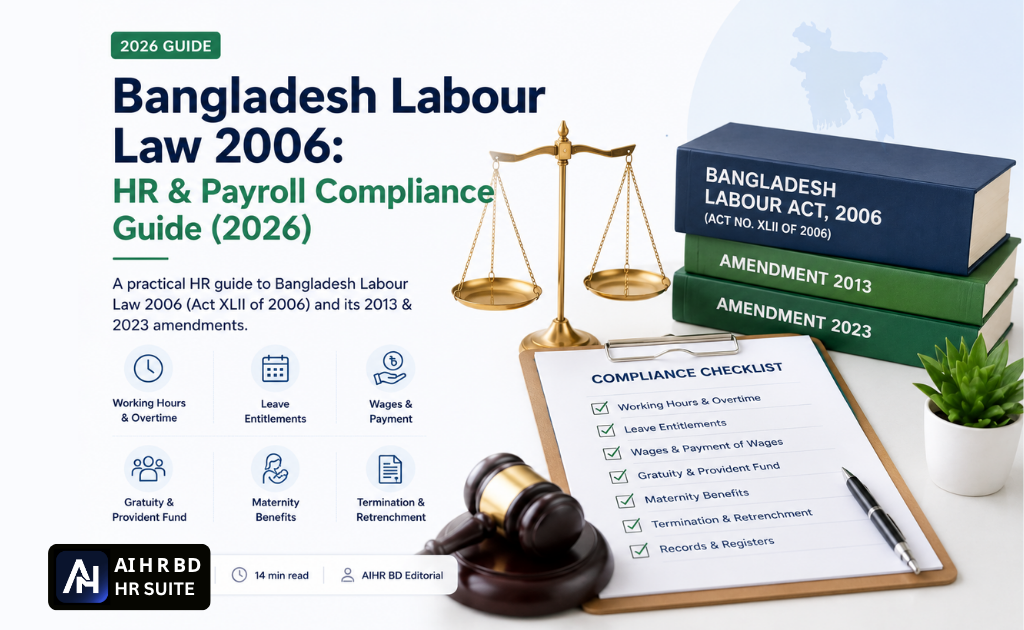
Bangladesh’s primary employment statute is the Bangladesh Labour Act, 2006 (Act No. XLII of 2006) — usually called the Bangladesh Labour Law 2006. It was significantly amended in 2013 and again in 2023, and is implemented through the Bangladesh Labour Rules, 2015 (amended 2022). For any HR or payroll function operating in Bangladesh, this is the law you must comply with.
If you are evaluating platforms, see our guide to HR software built for Bangladesh — it covers local compliance, BDT pricing and bKash/Nagad payroll in one place.
This guide is written for HR managers, payroll officers and founders — not lawyers. It explains the parts of the law you touch every month: working hours, leave, wages, overtime, gratuity, provident fund, maternity benefits, termination and the records you must keep. Where helpful we note how AIHR BD automates the calculation, but the obligations exist regardless of the tool you use.
This article is general guidance, not legal advice. For specific cases — especially termination disputes, factory licensing or trade-union matters — consult a Bangladeshi labour-law practitioner or the Department of Inspection for Factories and Establishments (DIFE).
1. What the Bangladesh Labour Act 2006 covers
The Act consolidated 25 earlier labour laws into one statute. It applies to most shops, commercial establishments, factories, road transport, tea plantations, ports and contractors operating in Bangladesh. A few categories are excluded — government offices, security-printing presses, certain agricultural farms with fewer than 5 workers, and family-only establishments — but virtually every private-sector employer in Bangladesh is covered.
Key chapters HR teams deal with most:
- Chapter II — Conditions of service & employment (appointment letters, ID cards, classification of workers, service books)
- Chapter IV — Working hours & leave
- Chapter V — Wages & payment of wages
- Chapter VI — Maternity benefit
- Chapter IX — Provident funds
- Chapter XII — Compensation for injury (workplace accidents)
- Chapter XV — Trade unions & industrial relations
- Chapter XXVI — Penalties (yes, non-compliance is criminal, not just civil)
2. Worker classification — get this right first
Section 4 of the Act recognises six categories of workers, and the entitlements (leave, notice period, gratuity eligibility) depend on the category:
| Category | Definition | Typical use |
|---|---|---|
| Apprentice | Under training | Trainees |
| Badli | Substitute for a permanent worker | Temporary cover |
| Casual | Engaged on a casual basis | Short ad-hoc work |
| Temporary | Engaged for work of a temporary nature | Project work |
| Probationer | On probation, max 6 months (3 months for clerical) | New hires |
| Permanent | Confirmed after probation or 6 months continuous service | Regular employees |
HR action: Every employee must receive an appointment letter and ID card (Section 5) stating their category. Misclassifying a permanent worker as a “casual” to avoid gratuity is one of the most common violations DIFE inspectors look for.
3. Working hours & overtime
The Act sets clear limits:
- Daily hours: Max 8 hours, extendable to 10 with overtime (Section 100)
- Weekly hours: Max 48 hours, extendable to 60 with overtime, with an annual average of 56 (Section 102)
- Rest interval: At least 1 hour after 6 hours of work, or ½ hour after 5 hours (Section 101)
- Weekly holiday: 1.5 days for shops/commercial establishments, 1 day for factories (Section 103)
- Overtime rate: Twice (2×) the basic wage + dearness allowance (Section 108)
Common mistake: Calculating overtime on gross salary. The law says basic + DA only — including HRA, medical or conveyance inflates the rate and your payroll cost. AIHR BD’s payroll engine uses the legally correct base by default.
4. Leave entitlements
This is where most HR teams over- or under-pay. The minimums under the 2006 Act (as amended) are:
- Casual leave: 10 days/year, full pay (Section 115). Not carried forward.
- Sick leave: 14 days/year, full pay, on production of a registered medical practitioner’s certificate (Section 116).
- Annual (earned) leave: 1 day for every 18 days worked in shops, commercial establishments and industrial establishments; 1 day for every 22 days worked in tea plantations; 1 day for every 11 days worked for adolescents (Section 117). Earned after 1 year of continuous service. Up to 40 days may be carried forward (60 for factory workers).
- Festival holidays: 11 days/year with full wages (Section 118).
- Maternity leave: see Section 6 below.
HR action: Your HRIS should accrue earned leave monthly based on attendance, cap CL at 10/year, and refuse SL without a medical certificate. AIHR BD’s leave module enforces these defaults out of the box and lets you raise them per company policy — never lower.
5. Wages & payment of wages
Chapter V is short but strict:
- Wages must be paid before the 7th of the following month (Section 123).
- Pay must be in legal tender — bank transfer, mobile financial services (bKash/Nagad/Rocket) and cheque are all acceptable since the 2018 DIFE circular.
- Permissible deductions are listed exhaustively in Section 125: PF, income tax, court-ordered, advances, fines (with limits), house rent if employer-provided, etc. You cannot deduct for till shortages, customer damages or “discipline” without following the formal procedure in the Rules.
- A wage register (Form 38) and wage slip (Form 39) are mandatory under the Labour Rules, 2015.
Payroll compliance checklist:
- Pay by the 7th — automate the cycle.
- Issue a payslip every month (digital is fine if the employee can access it).
- Keep 5 years of wage registers (Rule 121).
- Deduct income tax as per the Income Tax Act 2023 and deposit by the 15th of the following month.
- Deduct and deposit PF contributions (see Section 7).
6. Maternity benefit
After the 2013 amendment, Bangladesh provides one of South Asia’s stronger maternity protections:
- 16 weeks total — 8 weeks before and 8 weeks after delivery (Section 46).
- Eligibility: at least 6 months’ continuous service with the employer.
- Limit: payable for up to 2 surviving children. Beyond that, leave may be granted but without pay.
- Calculation: the daily benefit = total wages earned in the 3 months preceding the notice ÷ days actually worked (Section 48).
- No dismissal of a pregnant worker is allowed during this period without the Inspector’s prior permission (Section 50).
HR action: Configure your payroll to treat maternity-leave days as paid working days for attendance, and pre-calculate the lump-sum (many employers pay it in two instalments — 8 weeks before delivery, balance after).
7. Provident Fund (PF)
Under Chapter IX, Sections 264–267:
- A PF is mandatory in any private establishment where three-fourths of the workers demand it in writing.
- Tea plantations, newspapers and some specified industries must maintain a PF regardless of employee demand.
- Minimum contribution: 7%–8% of basic wages by both employee and employer (rate set in the trust deed, but not below the statutory floor).
- Funds must be held in a registered PF trust with employee representation on the board of trustees.
- The trust must be approved by the National Board of Revenue (NBR) so employee contributions qualify for the investment rebate under the Income Tax Act 2023.
Payroll integration: Deduct the employee share monthly, add the employer share, and remit to the trust account by the deadline in your PF rules (usually the 15th). AIHR BD posts both legs to the GL automatically when PF is enabled on a salary structure.
8. Gratuity & terminal benefits
Gratuity is defined in Section 2(10) and payable under Section 26 & 27:
- Eligibility: at least 6 months of continuous service for the death-of-worker case; most employer policies require 1 year, and gratuity is mandatory on dismissal/retirement after at least 6 months of service in the manner prescribed.
- Standard formula:
- 30 days’ wages per completed year for service up to 10 years
- 45 days’ wages per completed year for service above 10 years
- “Wages” here means basic wages last drawn.
- Gratuity is in addition to any other terminal benefits (PF, leave encashment, festival bonus due, etc.).
Other terminal payments to remember on exit:
- Notice pay — 120 days for permanent workers in case of retrenchment, 60 days in case of discharge (Sections 20, 26).
- Leave encashment — unused earned leave must be paid out at the basic wage rate (Section 117(8)).
- Compensation for retrenchment — 30 days’ wages per completed year (Section 20).
9. Termination — the part that gets employers in trouble
The Act distinguishes between:
- Termination simpliciter (Section 26) — no reason needed, but 120 days’ notice or pay in lieu for permanent workers, plus 30 days’ wages per year of service as compensation.
- Discharge for physical/mental incapacity or continued ill-health (Section 22) — with 30 days’ wages per year of service.
- Dismissal for misconduct (Section 23) — only after a domestic enquiry following the procedure in Section 24. Misconduct is exhaustively listed (theft, fraud, habitual absence, willful disobedience, etc.). Without a proper enquiry, dismissal is almost always overturned by the Labour Court.
- Resignation by the worker (Section 27) — 60 days’ notice for permanent workers, or pay in lieu.
Documentation HR must keep on file for every exit:
- Show-cause notice (if misconduct)
- Enquiry report
- Termination/dismissal letter
- Full and final settlement sheet (notice, gratuity, leave encashment, PF release, last salary)
- Service certificate (Section 31 — cannot contain anything adverse to the worker)
10. The 2013 amendment — what changed
The Bangladesh Labour (Amendment) Act, 2013 was passed after the Rana Plaza tragedy and strengthened safety and workers’ rights:
- Group insurance mandatory for establishments with 100+ permanent workers
- 5% of net profit of certain companies to be paid into the Workers’ Profit Participation Fund (WPPF)
- Easier trade-union registration — only 20% of workers needed (down from 30%)
- Stronger fire safety, building safety and electrical safety obligations
- Enhanced compensation for workplace death (now Tk 200,000 minimum, increased to Tk 500,000 by later schedule amendments)
11. The 2023 amendment — what changed
The Bangladesh Labour (Amendment) Act, 2023 brought the law closer to ILO conventions and the EU GSP+ requirements:
- Maternity benefit calculation clarified to favour the worker
- Penalties increased substantially for unfair labour practices and unsafe workplaces
- Compensation for workplace death/permanent disability raised
- Definition of “worker” widened to include several previously excluded categories
- Appellate Tribunal procedures simplified to speed up labour-court cases
- Stronger anti-discrimination and anti-harassment language
12. Records you must keep (Labour Rules, 2015)
Inspectors typically ask for these on a visit. Keep them for at least 5 years:
| Form | Purpose |
|---|---|
| Form 5 | Service book of each worker |
| Form 25 | Leave register |
| Form 28 | Overtime register |
| Form 34 | Muster roll (daily attendance) |
| Form 38 | Wage register |
| Form 39 | Wage slip |
| Form 23 | Identity card register |
A modern HRIS like AIHR BD generates these forms on demand from the same data you already enter for payroll — no parallel registers needed.
13. Penalties for non-compliance
Chapter XXVI lays out criminal penalties — not just fines on the company, but on the employer/manager personally:
- Failure to pay wages by the 7th: up to Tk 10,000 fine + 100% of unpaid wages as compensation
- Employing a child below 14: up to 5,000 Tk + 1 year imprisonment
- Causing death by safety violation: up to Tk 1,00,000 + 4 years imprisonment
- General penalty for any contravention without specific punishment: Tk 25,000
Labour Court can also reinstate a worker with full back wages — often the single largest financial exposure.
14. A 12-point HR compliance checklist
Use this monthly with your payroll close:
- ✅ Every active employee has an appointment letter and ID card
- ✅ Attendance captured daily (biometric or app) and reconciled with leave
- ✅ Overtime calculated at 2× basic+DA, not gross
- ✅ Casual / sick / earned leave balances accrued and capped per the Act
- ✅ Wages paid by the 7th of the following month
- ✅ Payslip issued with all statutory deductions itemised
- ✅ Income tax deducted per Income Tax Act 2023 and deposited by the 15th
- ✅ PF deducted (where applicable) and remitted to the trust
- ✅ Maternity benefit pre-calculated for any worker due in the next 8 weeks
- ✅ Gratuity provision posted to the books each month
- ✅ All statutory registers (muster roll, wage register, leave register, OT register) up to date
- ✅ Workplace safety inspection log and group insurance (if 100+ workers) current
15. How AIHR BD helps
AIHR BD is built specifically for Bangladesh Labour Law 2006 compliance:
- Worker categories, appointment letters and ID cards generated automatically
- Attendance integrated with ZKTeco, Hikvision, Dahua and Tipsoi devices
- Leave engine pre-configured with CL/SL/EL minimums and carry-forward caps
- Payroll with NBR-compliant tax slabs, PF, gratuity provisioning and 2× basic+DA overtime
- Maternity benefit and full & final settlement workflows
- Salary disbursement via bKash, Nagad and bank transfer
- All statutory forms (Form 25, 28, 34, 38, 39) one-click exportable for DIFE inspections
Start a free trial or book a demo — we’ll map your existing process to the Act in under 30 minutes.
Further reading
- Best HR Software in Bangladesh (2026)
- HRM Software Buyer’s Guide for Bangladesh
- Salary Sheet Format for Bangladesh (BDT)
Related reading
Frequently asked questions
- What is the maximum working hours per week under the Bangladesh Labour Act 2006?
- Section 100 caps normal working hours at 8 per day and 48 per week. With overtime (Section 102), an adult worker may work up to 60 hours per week and 56 hours per week on a yearly average. Overtime must be paid at twice the ordinary hourly wage.
- How many days of leave are employees entitled to in Bangladesh?
- The Labour Act 2006 grants three statutory leave types: 10 days of casual leave (Section 115), 14 days of sick leave with full wages (Section 116), and earned/annual leave at 1 day per 18 working days for adults — roughly 17 days per year (Section 117). These are minimums; employer policy can be more generous.
- What is the maternity leave entitlement under Bangladesh Labour Law?
- Section 46 entitles a woman to 16 weeks of paid maternity leave — 8 weeks before and 8 weeks after delivery — provided she has worked for the employer for at least 6 months before the expected delivery date. Maternity benefit is paid at the daily average wage of the 3 months preceding the leave.
- When is gratuity payable under Bangladesh Labour Law?
- Gratuity is mandatory only for permanent workers with at least 1 years continuous service who are terminated, dismissed, retired or resign (Sections 26 and 27). The minimum rate is 30 days basic wage for each completed year of service, with proportionate calculation for partial years above 6 months.
- What notice period is required for termination in Bangladesh?
- Section 26 requires 120 days written notice (or 120 days basic wages in lieu) for permanent workers and 60 days for temporary workers. Workers dismissed for misconduct (Section 23) get no notice but require a written charge sheet, a domestic enquiry and an opportunity to be heard before dismissal.