
Run this in AIHR BD instead of a spreadsheet
NBR-compliant payroll, ZKTeco & Hikvision attendance sync and bKash/Nagad salary disbursement — 14-day free trial, no credit card required.
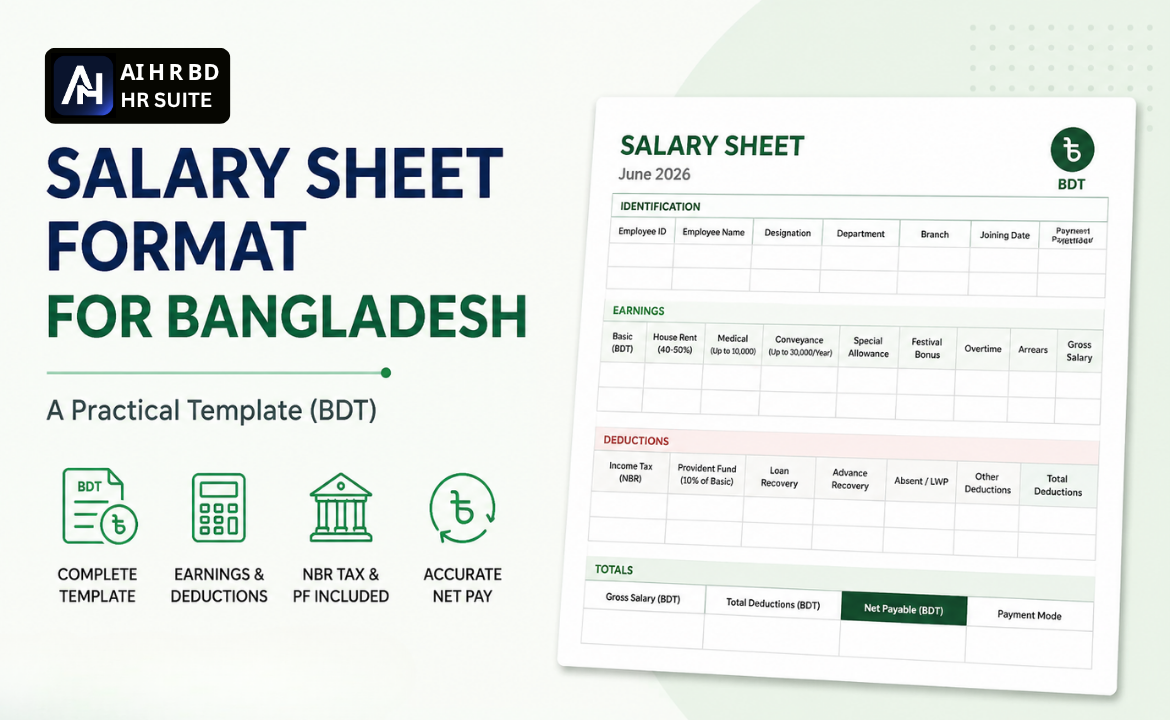
Managing payroll in Bangladesh requires a meticulous approach, blending local regulations with efficient processing. A well-structured salary sheet is not just a document; it's a critical tool for compliance, financial transparency, and employee satisfaction. This guide outlines the essential components and best practices for creating a compliant and effective salary sheet in Bangladesh.
Key takeaways
- A comprehensive salary sheet for Bangladesh integrates identification details, earnings, deductions, and accurate net pay calculation.
- NBR regulations dictate specific tax exemptions for allowances like house rent, medical, and conveyance that must be applied precisely.
- Common deductions include NBR income tax, Provident Fund contributions, and adjustments for absences or loans.
- Meticulous calculation and clear documentation are paramount to avoid payroll errors and ensure NBR compliance.
- Automating payroll processes significantly reduces manual effort, minimizes errors, and enhances regulatory adherence for growing businesses.
Anatomy of a Bangladeshi salary sheet
A thorough monthly salary sheet in Bangladesh is systematically divided into three primary sections: identification, earnings, and deductions, culminating in a net payable amount.
Identification details
These columns are essential for uniquely identifying the employee and ensuring accurate payment disbursement:
- Employee ID
- Employee Name
- Designation
- Department
- Branch
- Joining Date
- Bank Account Number / bKash / Nagad Number
Earnings components
This section details all forms of remuneration an employee receives, adhering to typical Bangladeshi payroll structures:
- Basic Salary: The fundamental component, typically ranging from 50-60% of the gross salary.
- House Rent Allowance: Generally 40-50% of the basic salary, subject to NBR-stipulated tax exemptions.
- Medical Allowance: Often a fixed amount, tax-exempt up to ৳10,000 per month as per current NBR rules.
- Conveyance Allowance: Tax-exempt up to ৳30,000 per year.
- Special Allowance: Any other fixed allowance not categorized above.
- Festival Bonus: Typically disbursed twice a year around Eid-ul-Fitr and Eid-ul-Azha, often equivalent to one basic salary. For detailed guidance, see our post on Festival bonus done right: Eid payroll without the chaos.
- Overtime: Payment for hours worked beyond the standard workweek or contracted hours.
- Arrears: Payments for previous periods, usually due to retroactive salary adjustments or unpaid dues.
Deduction components
These are amounts legally or contractually subtracted from the employee's gross earnings:
- Income Tax (NBR): Calculated based on the taxable income slabs and current NBR regulations, considering eligible investment rebates and minimum tax requirements.
- Provident Fund (PF): Typically a 10% deduction from the employee's basic salary, often matched by the employer's contribution.
- Loan Recovery: Installments for company loans or salary advances provided to the employee.
- Advance Recovery: Repayment of salary advances.
- Absent / Leave Without Pay (LWP): Deductions for unauthorized absences or approved leave without pay. This is commonly calculated as: (Gross Salary ÷ Total Working Days in the Month) × Number of LWP Days.
- Other Deductions: Any other authorized deductions as per company policy or employee agreement.
Calculating net payable
The net payable amount represents the final sum an employee receives after all deductions are applied.
Net Pay (BDT) = (Basic + House Rent + Medical + Conveyance + Special + Bonus + Overtime + Arrears) − (Income Tax + PF + Loan + Advance + Absent + Other Deductions)
The final amount should ideally be rounded to the nearest BDT 1 before disbursement. It's also crucial to record the Payment Mode (e.g., bank transfer, bKash, or Nagad) for accurate reconciliation. Understanding how digital payments integrate into payroll is essential; explore Why bKash and Nagad payments matter for payroll.
Essential considerations for NBR compliance
Ensuring your salary sheet adheres to NBR regulations is vital for avoiding penalties and audits. Here’s a checklist for compliance:
| Feature | Consideration | Status |
|---|---|---|
| Tax Exemption Limits | Confirm house rent, medical, and conveyance allowances comply with NBR limits. | ✅ |
| Investment Rebate | Apply eligible investment rebates to legally reduce employee income tax. | ✅ |
| Minimum Tax | Ensure minimum tax obligations are met according to NBR guidelines. | ✅ |
| Provident Fund Updates | Review and update PF calculations promptly with any basic salary changes. | ✅ |
| Gross vs. Taxable Income | Maintain a clear distinction between these for accurate tax computation. | ✅ |
| Festival Bonus Handling | Ensure bonuses are correctly taxed and recorded, even if processed separately. | ✅ |
Always consult the latest NBR circulars for updated tax exemption thresholds and regulatory changes.
Common payroll mistakes to avoid
Many businesses, particularly SMEs, frequently encounter errors that can lead to NBR non-compliance, financial discrepancies, or employee dissatisfaction.
- Confusing Gross vs. Taxable Income: A common error is failing to differentiate gross earnings from taxable income after applying NBR exemptions, leading to incorrect tax deductions.
- Ignoring Investment Rebate: Overlooking the NBR-mandated investment rebate means employees pay higher taxes than necessary, impacting their net take-home pay.
- Inconsistent Festival Bonus Processing: While often treated as a separate payment, Bangladesh's festival bonuses are taxable income and must be integrated into annual tax calculations correctly.
- Outdated PF Calculations: Failing to adjust Provident Fund contributions when an employee's basic salary changes can result in under- or over-deductions.
- Excessive Reliance on Excel: While flexible, Excel sheets lack audit trails, robust security, and automation for processes like payslip generation, significantly increasing manual effort and error risk as the company grows.
Beyond Excel: Automating payroll
As businesses expand, manual Excel-based payroll systems become increasingly inefficient and prone to errors. The administrative burden, compliance risks, and lack of scalability make automation a strategic imperative. Implementing a dedicated payroll system can dramatically streamline HR operations. Discover more about The ROI of payroll automation for Bangladeshi SMEs.
For example, AIHR BD offers a comprehensive solution that automates the entire payroll process for Bangladeshi businesses. It automatically applies NBR tax slabs, correctly calculates Provident Fund and gratuity, processes festival bonuses, and generates one-click disbursement files ready for bKash, Nagad, or bank transfers. Employees benefit from a self-service portal, providing easy access to payslips and other HR information, thereby enhancing transparency and reducing HR queries.
Related reading
- The ROI of payroll automation for Bangladeshi SMEs
- Festival bonus done right: Eid payroll without the chaos
- Why bKash and Nagad payments matter for payroll
A good HR software for Bangladeshi companies automates most of this — from attendance to payslips in BDT with NBR-compliant tax deductions.
Frequently asked questions
- What columns must a Bangladesh salary sheet include?
- A compliant salary sheet should carry: employee ID, name, designation, branch, basic, house rent, medical, conveyance, other allowances, gross, PF deduction, tax deduction (TDS), loan/advance deduction, other deductions, net payable, payment mode (bank/bKash/cash), and signature. The PF and TDS columns are needed for NBR audit.
- What is the standard salary breakdown structure in Bangladesh?
- Most Bangladeshi employers use: Basic 60%, House Rent 20%, Medical 10%, Conveyance 10% of gross — keeping basic at 60% controls PF and gratuity liability while keeping allowances tax-friendly. Allowances above NBR ceilings (house rent over 50% of basic or BDT 25,000, medical over 10% or BDT 120,000/yr) become taxable.
- How should salary sheets handle BDT formatting?
- Use Bangla Taka symbol (৳) or BDT prefix consistently, format with thousands separators (৳45,000.00), and show two decimal places for transparency on partial-month or pro-rated salaries. Avoid mixing ৳ and Tk in the same document.
- Do I need to keep salary sheets for audit in Bangladesh?
- Yes — under the Income Tax Ordinance and Labour Act 2006, employers must retain payroll registers and salary sheets for at least 6 years. NBR auditors, labour inspectors and PF trustees can request them at any time. Digital copies are accepted if signed/approved by the responsible HR or finance officer.