
Run this in AIHR BD instead of a spreadsheet
NBR-compliant payroll, ZKTeco & Hikvision attendance sync and bKash/Nagad salary disbursement — 14-day free trial, no credit card required.
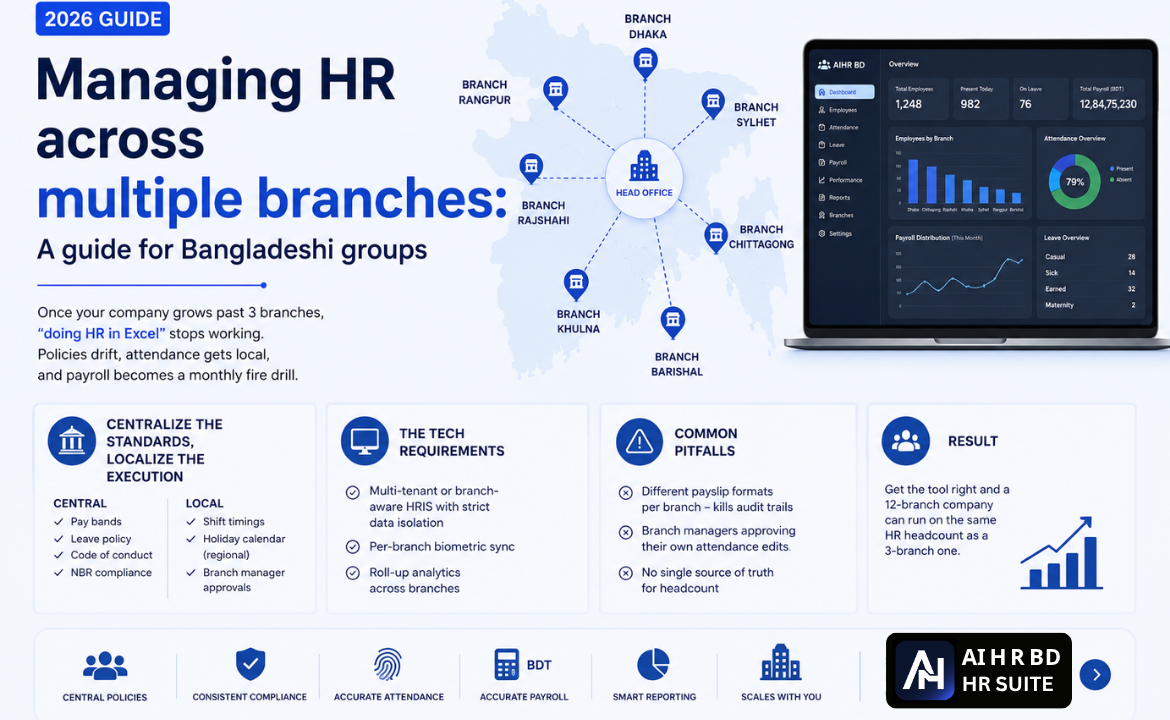
As your company expands across Bangladesh, managing Human Resources becomes increasingly complex. What works for a single office rapidly breaks down when you're overseeing multiple branches. This guide explores how to maintain consistent HR operations and policies across your multi-branch organization without getting bogged down in micromanagement.
Key takeaways
- Balance centralization and decentralization by setting core policies centrally and allowing local execution.
- Implement a multi-tenant HRIS that caters to branch-specific needs while providing overall oversight.
- Standardize biometric attendance systems across all locations for accurate, real-time data.
- Leverage robust analytics to gain actionable insights into multi-branch performance and identify trends.
- Avoid common pitfalls like inconsistent payslips or unapproved attendance edits through clear processes and technology.
Centralized Standards vs. Localized Execution
The core principle for multi-branch HR management is to centralize strategic direction while enabling localized execution. This ensures consistency and fairness across the organization, while allowing for essential flexibility.
What to centralize:
- Core Policies: Salary structures, pay bands, leave policies, code of conduct, and disciplinary procedures must be uniform. This minimizes confusion, fosters equity, and simplifies compliance.
- Legal & Regulatory Compliance: Ensure all branches adhere to Bangladesh's labor laws, NBR tax regulations, Provident Fund rules, and gratuity calculations. This prevents legal exposure and ensures timely submissions.
- HRIS and Data Management: Adopt a single, unified HR Information System (HRIS) as the authoritative source of truth for all employee data, attendance records, and payroll information.
- Performance Management Framework: Establish a consistent system for performance reviews, goal setting, and professional development across all branches.
What to localize:
- Specific Rostering and Shift Timings: Each branch may have unique operational hours and staffing needs. Shift schedules and daily rosters can be managed locally within central policy guidelines.
- Regional Holidays: While national holidays are universal, specific regional holidays or local cultural events might require tailored time-off allowances or office closures.
- Branch Manager Approvals: Empower branch managers to handle day-to-day approvals for leave requests, overtime, or minor disciplinary actions, provided they operate within defined policy frameworks.
- Local Training Needs: While core training might be centralized, some branches may have specific training requirements based on their operations or local market.
The Role of Technology in Multi-Branch HR
Effective technology is not just helpful—it's essential for scaling HR operations across multiple branches. Without the right tools, managing data, ensuring compliance, and generating reports becomes a monumental task.
Essential Tech Requirements:
- Multi-Tenant, Branch-Aware HRIS: Your HRIS must be designed to manage data for multiple entities or branches while maintaining strict data isolation. This allows for centralized oversight but offers individual branch-level access and reporting. Ideally, it should easily integrate with other systems like accounts.
- Standardized Biometric Attendance Systems: Implementing consistent biometric devices (e.g., ZKTeco, Hikvision) across all branches is critical. Data from these devices must seamlessly sync with your central HRIS in real-time. This ensures accurate timekeeping, reduces manual errors, and provides a clear audit trail. For a deeper dive, check out our guide on time tracking vs productivity.
- Unified Payroll Software: A single payroll system capable of processing salaries for all employees, regardless of their branch, is vital. This streamlines salary disbursement, automates NBR tax deductions, Provident Fund contributions, and gratuity calculations, and handles bank transfers or mobile payments (bKash/Nagad). See our salary sheet format for Bangladesh for best practices.
- Roll-Up Analytics and Reporting: The HRIS should offer robust reporting capabilities that allow you to view data by branch, region, or in aggregate. This enables HR and leadership to identify trends, benchmark performance, and make data-driven decisions across the entire organization. This includes metrics like headcount, turnover rates, absenteeism, and payroll costs per branch.
Benefits of a Unified Multi-branch HR Strategy
Implementing a well-structured multi-branch HR strategy offers significant advantages:
| Benefit | Description |
|---|---|
| Consistency | Ensures all employees, regardless of branch, are treated fairly under uniform policies and procedures. |
| Compliance | Reduces legal risks by ensuring all branches adhere to Bangladesh's labor laws, NBR regulations, and other statutory requirements. |
| Efficiency | Automates repetitive tasks, reduces manual errors, and streamlines payroll, attendance, and leave management across all locations. |
| Data Accuracy | Provides a single source of truth for all employee data, leading to better reporting and decision-making. |
| Strategic Insight | Offers deep analytics into branch performance, helping identify areas for improvement, resource allocation, and talent development. |
| Scalability | Allows your organization to grow and add new branches without disproportionately increasing HR administrative burden. |
| Employee Satisfaction | Fosters a sense of fairness and transparency, leading to higher morale and engagement. |
Common Pitfalls to Avoid
Scaling HR without proper planning can lead to significant operational headaches and compliance risks. Be mindful of these common challenges:
- Inconsistent Payslip Formats: Allowing different branches to use varied payslip formats creates confusion, complicates audits, and makes it difficult to ensure standardized deductions and compliances. A single, unified format enforced by your HRIS is crucial.
- Uncontrolled Attendance Edits: When branch managers can unilaterally approve or edit their own or their team's attendance records without proper oversight or audit trails, it opens the door to abuse and inaccurate payroll. Implement a system where all attendance adjustments require multi-level approval within the HRIS.
- Lack of a Single Source of Truth for Headcount: Without a centralized HRIS, getting an accurate, real-time headcount across all branches becomes a major challenge. This impacts everything from recruitment planning to budgeting and compliance reporting.
- Fragmented Employee Records: Keeping employee files in disparate systems or even physical folders at each branch leads to inefficiency, data loss risks, and difficulty in accessing comprehensive employee histories.
- Inconsistent Disciplinary Actions: If disciplinary actions or performance management are handled inconsistently across branches due to a lack of clear policy and oversight, it can lead to legal challenges and low employee morale.
By standardizing processes and leveraging the right technology, a 12-branch company can operate with the same HR efficiency as a 3-branch company. This strategic investment in HR infrastructure is key to sustainable growth. Explore managing remote work in Bangladesh for additional insights into distributed team management.
Related reading
- Managing remote work in Bangladesh: Tools and best practices
- Time tracking vs productivity: Finding the right balance
- Salary Sheet Format for Bangladesh: A Practical Template (BDT)
For a broader view of what to look for, read our overview of HR software in Bangladesh, including deployment options, Bangla support and local payment integrations.
Frequently asked questions
- How can I manage payroll consistently for multiple company branches in Bangladesh?
- To manage payroll consistently across multiple branches, implement a unified payroll system capable of processing salaries for all employees regardless of their location. This streamlines salary disbursement, automates NBR tax deductions, Provident Fund contributions, and gratuity calculations according to Bangladesh Labour Act 2006. It also facilitates direct bank transfers or mobile payments via bKash/Nagad, ensuring fairness and efficiency.
- What is the best way to track employee attendance across different office locations in Bangladesh?
- The most effective way is to standardize biometric attendance systems (e.g., ZKTeco, Hikvision) across all branches. Ensure these devices seamlessly sync data with a central, multi-tenant HRIS in real-time. This provides accurate timekeeping, reduces manual errors, and offers a clear audit trail for compliance with Bangladesh's labor regulations.
- How do I ensure all my branches in Bangladesh comply with NBR tax rules and labor laws?
- Centralize all core HR policies, including legal and regulatory compliance, to ensure all branches adhere to Bangladesh's Labour Act 2006, NBR tax regulations, and Provident Fund rules. A unified HRIS helps enforce these policies consistently and ensures timely submissions to prevent legal exposure. Empower local managers with day-to-day approvals while maintaining central oversight of policy frameworks.
- What kind of HR software is best for managing HR functions for a group of companies in Bangladesh?
- A multi-tenant, branch-aware HRIS is essential for managing HR functions across a group of companies. This type of system allows for centralized oversight while providing individual branch-level access and reporting. It should integrate with standardized biometric attendance systems and unified payroll software to handle all employee data, attendance, and salary processing (including BDT, NBR, bKash/Nagad) efficiently.