
Run this in AIHR BD instead of a spreadsheet
NBR-compliant payroll, ZKTeco & Hikvision attendance sync and bKash/Nagad salary disbursement — 14-day free trial, no credit card required.
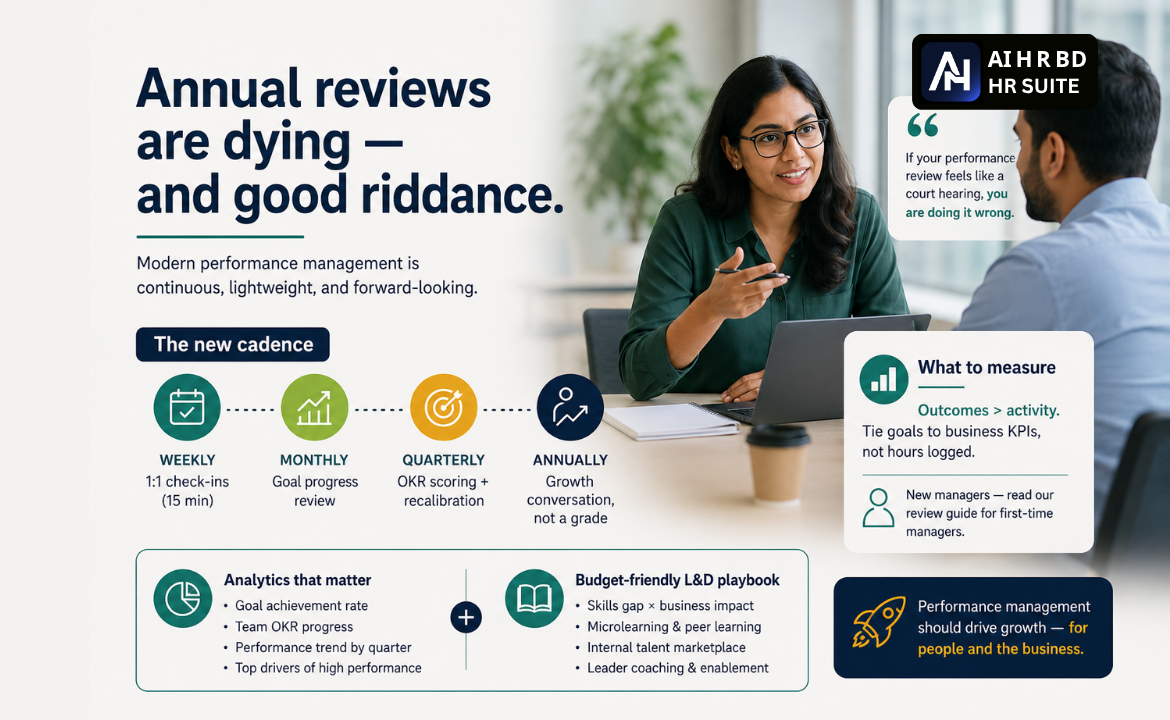
Effective performance management is crucial for employee growth and organizational success. While traditional annual reviews often fall short, modern approaches focus on continuous feedback, clear goal setting, and development. This guide will walk you through implementing a dynamic performance management system tailored for the Bangladeshi workplace.
Key takeaways
- Shift from annual reviews to continuous feedback: Regular check-ins and ongoing dialogue foster a culture of growth.
- Embrace Objectives and Key Results (OKRs): Set clear, measurable goals that align individual contributions with company objectives.
- Focus on outcomes, not just activity: Evaluate performance based on tangible results and business impact.
- Integrate development with performance: Link feedback to learning opportunities and career progression.
- Leverage technology for efficiency: HR software can streamline goal tracking, feedback collection, and performance reporting.
The outdated annual review vs. continuous performance management
For years, the annual performance review was the cornerstone of employee evaluation. However, this infrequent, often retrospective process is increasingly seen as ineffective. It's too infrequent to address issues promptly, too formal to encourage honest dialogue, and often focuses on past mistakes rather than future development.
Modern performance management champions a continuous, lightweight, and forward-looking approach. It replaces the dreaded annual judgment with ongoing conversations, regular feedback, and proactive coaching. This creates a supportive environment where employees feel valued, informed, and continuously challenged to improve.
If your performance review feels like a court hearing, you are doing it wrong.
A new cadence for performance discussions
Moving from annual reviews doesn't mean abandoning structure. Instead, it means adopting a more frequent, tiered cadence for performance discussions:
Weekly 1:1 Check-ins
- Duration: 15-30 minutes
- Focus: Open discussion between manager and employee. Review progress on immediate tasks, address blockers, provide quick feedback, and discuss current priorities.
- Outcome: Enhanced communication, quick problem-solving, and a clear understanding of immediate next steps.
Monthly Goal Progress Reviews
- Duration: 30-60 minutes
- Focus: Deeper dive into individual and team goals. Are employees on track? What support is needed? Are there any shifts in priorities? Align individual work with larger team objectives.
- Outcome: Mid-course corrections, reassessment of resource needs, and sustained momentum towards objectives.
Quarterly OKR Scoring & Recalibration
- Duration: 1-2 hours (team discussions); individual follow-ups
- Focus: A formal review of Objectives and Key Results (OKRs). Score progress, celebrate achievements, identify areas for improvement, and set new OKRs for the upcoming quarter. This is a critical time for strategic alignment. Ensure individual OKRs contribute to overall company goals.
- Outcome: Strategic alignment, clear quarterly objectives, and opportunities for significant course adjustments.
Bi-annual or Annual Growth Conversations
- Duration: 1-2 hours
- Focus: Not a grading session, but a comprehensive career development discussion. Review overall performance trends, discuss career aspirations, identify learning and development opportunities, and plan for future growth within the company. This is where personal growth plans are nurtured.
- Outcome: Employee development plans, career path clarity, and strong retention.
Setting clear goals with OKRs
Objectives and Key Results (OKRs) are a powerful framework for setting and achieving ambitious goals. Unlike traditional MBOs (Management by Objectives), OKRs are typically public, ambitious, and reviewed frequently.
- Objectives: What do we want to achieve? These should be inspiring, qualitative, and time-bound.
- Key Results: How will we know if we've achieved it? These must be measurable, specific, and challenging.
Consider this example for a customer service team in Bangladesh:
| Component | Example (Customer Service Team) |
|---|---|
| Objective | Delight our customers with exceptional support. |
| Key Result 1 | Reduce average first response time to under 30 seconds. |
| Key Result 2 | Increase customer satisfaction (CSAT) score to 90%. |
| Key Result 3 | Reduce customer complaint resolution time by 20%. |
Aligning OKRs: Ensure individual and team OKRs cascade from departmental and organizational goals. This ensures everyone is pulling in the same direction towards common strategic targets.
Focus on outcomes, not just activity
A common pitfall in performance management is judging employees based on their activity rather than their actual results. It’s easy to confuse being busy with being productive. Modern performance management emphasizes outcomes over activity.
- Activity-based thinking: "Employee X logs 10 hours of work daily and attends all meetings."
- Outcome-based thinking: "Employee Y successfully launched the new bKash payment integration, leading to a 15% increase in online sales."
When setting goals and evaluating performance, always ask: "What tangible results did this person or team achieve that contributed to the business?"
For managers, mastering this outcome-oriented approach is critical. For new managers, exploring resources like a performance review guide for first-time managers can be invaluable.
Integrating development and feedback
Performance management isn't just about evaluation; it's fundamentally about employee development. Continuous feedback, coaching, and growth opportunities are integral.
- Regular Feedback: Encourage 360-degree feedback, not just top-down. Peer feedback and self-assessment contribute to a more holistic view.
- Growth Plans: Link performance discussions to individual development plans. What skills does the employee need to acquire? Are there specific training programs or mentors who can help?
- Learning Opportunities: Provide access to relevant learning resources, whether it's an online course, a workshop, or on-the-job training. Consider a budget-friendly L&D playbook if resources are tight.
By focusing on development, performance management transforms from a dreaded assessment to a collaborative journey of growth. This proactive approach not only improves individual performance but also boosts engagement and retention.
Leveraging tech for efficient performance management
In Bangladesh, HR technology adoption is growing, making it easier to implement these modern performance management practices. HR software can help with:
- Goal Tracking: Easily set, track, and update OKRs for individuals and teams.
- Feedback Collection: Facilitate continuous feedback loops, peer reviews, and manager check-ins.
- Performance Analytics: Generate reports on performance trends, goal attainment, and development progress.
- Integrations: Connect with other HR modules like payroll (e.g., integrating performance bonuses into a salary sheet format for Bangladesh) or learning management systems.
Platforms can streamline the entire process, reducing administrative burden and allowing HR teams and managers to focus on meaningful interactions.
Related reading
Frequently asked questions
- How does modern performance management compare to traditional annual reviews?
- Modern performance management replaces the once-a-year review with continuous feedback and regular check-ins, so issues are addressed promptly. Combined with clear goals such as OKRs and a link to development plans, it creates a culture where employees feel supported and keep improving.
- What is a good cadence for performance discussions in a Bangladeshi company?
- Use a tiered rhythm: weekly one-to-one check-ins for immediate work, monthly goal progress reviews, and quarterly OKR scoring and recalibration. Bi-annual or annual conversations should focus on career growth rather than grading.
- Can Objectives and Key Results work well for Bangladeshi businesses?
- Yes. OKRs help set clear, ambitious, measurable goals and ensure individual contributions align with company objectives, whether that is raising customer satisfaction or cutting response times. The transparency of shared targets is the main benefit.
- How can HR software support modern performance management?
- HR software automates goal tracking, collects continuous feedback, and generates performance reports. It helps managers and employees keep up with weekly check-ins, monthly goal reviews, and quarterly OKR assessments with far less admin.