
Run this in AIHR BD instead of a spreadsheet
NBR-compliant payroll, ZKTeco & Hikvision attendance sync and bKash/Nagad salary disbursement — 14-day free trial, no credit card required.
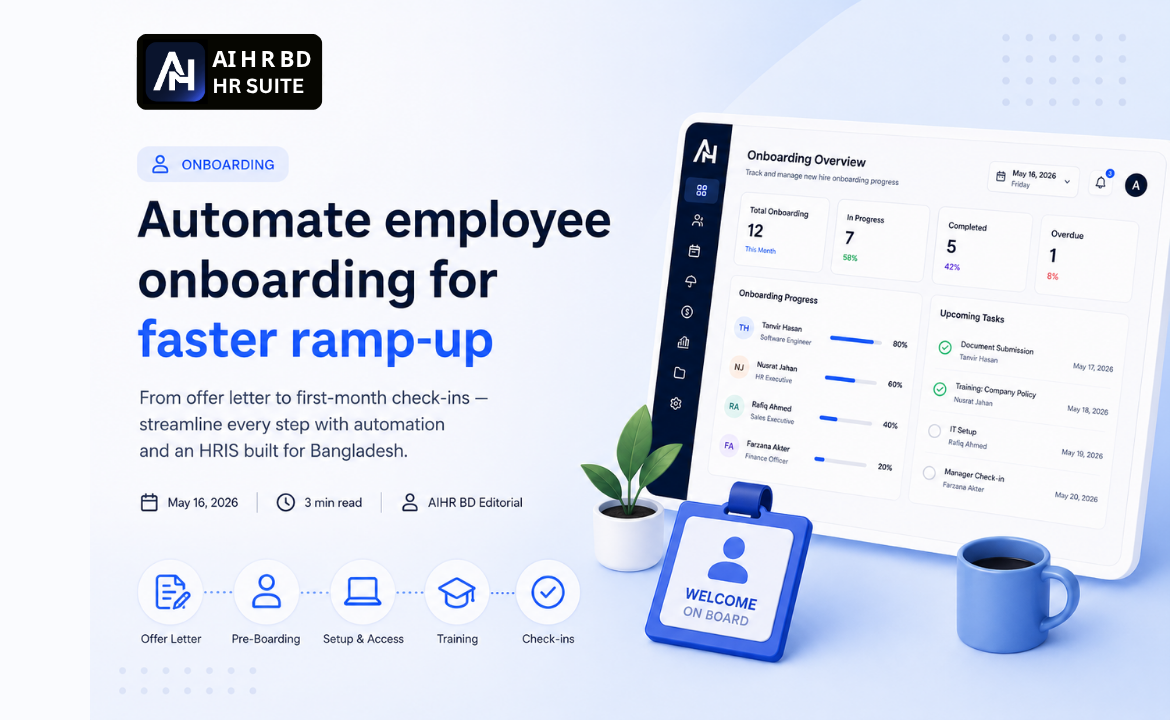
The first impression an employee gets of your company can significantly impact their long-term engagement and retention. Automated onboarding transforms a potentially chaotic beginning into a smooth, structured experience, helping new hires feel confident, productive, and connected from day one.
If you are evaluating platforms, see our guide to HR software built for Bangladesh — it covers local compliance, BDT pricing and bKash/Nagad payroll in one place.
Key takeaways
- Pre-boarding sets the stage: Essential tasks completed before day one prevent delays and allow new hires to focus on learning.
- Structured first month is crucial: A well-defined first month enhances engagement and retention, making employees feel supported.
- Automation boosts efficiency: Automating repetitive tasks frees HR to focus on strategic initiatives and provides a consistent experience.
- Self-service empowers employees: Giving new hires access to their information and tasks increases transparency and reduces HR workload.
- Improved retention and performance: Companies with structured onboarding see higher new-hire retention and faster ramp-up times.
Day 0: The Pre-Boarding Checklist
A successful onboarding journey truly begins before an employee's first working day. Completing essential tasks proactively avoids confusion and delays, allowing new hires to hit the ground running.
Key Pre-Boarding Activities
- Offer letter: Digitally signed and confirmed.
- Bank/bKash account information: Collected for salary processing.
- Tax declaration forms: Pre-filled as much as possible for NBR compliance.
- Work tools: Company email, device, and software access provisioned.
- Orientation documents: Initial company handbook and policy overview shared.
When these basics are handled early, employees can focus on learning and contributing from their actual start date instead of being bogged down by administrative paperwork.
Modern HRIS solutions can automate these steps, sending out forms, tracking submissions, and even integrating with IT to provision accounts, significantly streamlining the process.
Week 1–4: Building Momentum and Engagement
The first month is critically important for employee engagement and long-term retention. During this period, companies should structure and automate the onboarding process to ensure a consistent and enriching experience.
Essential First-Month Onboarding Elements
- Automated training modules: Assign mandatory compliance training, safety protocols, and software tutorials.
- Scheduled introductions: Facilitate meetings with team members, direct managers, and key stakeholders.
- Regular manager check-ins: Schedule 1-on-1s to discuss progress, answer questions, and provide early feedback.
- Clear milestones and expectations: Outline what new hires should achieve by week 1, 2, and 4.
- Mentorship program: Assign a buddy or mentor to guide the new hire culturally and professionally.
A well-designed onboarding playbook ensures every employee, regardless of their department or role, receives a consistent, professional, and supportive experience. For a comprehensive guide, check out The complete employee onboarding checklist for 2026.
Why Structured Onboarding Matters for Your Business
The impact of a structured onboarding program is undeniable. According to BambooHR research, companies with such programs experience an 82% higher new-hire retention rate.
| Onboarding Approach | New-Hire Retention | Time to Productivity | Employee Engagement |
|---|---|---|---|
| Structured | Up to 82% higher | Significantly faster | Higher |
| Unstructured | Lower | Slower | Lower |
Employees who feel supported from day one are not only more likely to stay longer but also perform better and integrate faster into the company culture. This translates directly to reduced recruitment costs, improved team morale, and higher overall productivity.
The Power of Employee Self-Service Portals
Modern onboarding thrives when integrated with an employee self-service portal. This powerful tool empowers new hires by giving them control and transparency from their very first day.
Benefits of Self-Service for New Hires
- Personal information updates: New employees can easily input and update their personal details, beneficiaries, and emergency contacts.
- Document management: Securely upload required documents like NID, educational certificates, and employment contracts.
- Access to resources: Instantly access company policies, employee handbooks, organizational charts, and FAQs.
- Onboarding progress tracking: Monitor their own progress through assigned tasks and pending items.
- Payroll and tax details: Independently manage bank details, view pay slips, and update NBR tax declaration information.
Implementing self-service tools significantly reduces the administrative burden on your HR team. Instead of manually collecting and verifying data, HR can focus on strategic onboarding elements like cultural integration and performance enablement.
Automating for the Future
Leveraging an HRIS to automate onboarding tasks not only streamlines operations but also ensures compliance and consistency. From sending automated reminders for pending tasks to integrating with payroll systems for accurate salary processing, automation minimizes human error and maximizes efficiency.
For instance, an HRIS can:
- Automatically send welcome emails with necessary links and documents.
- Assign training modules based on role and department.
- Schedule calendar invites for introductory meetings.
- Track the completion of all onboarding steps for audit purposes.
By automating these processes, HR teams in Bangladesh can ensure every new hire has a stellar entry into the organization, leading to quicker ramp-up times and stronger foundational relationships.
Related reading
Frequently asked questions
- How can I automate new hire payroll setup in Bangladesh, especially with bKash or Nagad?
- Collect bank account or mobile financial service details like bKash and Nagad during pre-boarding through digital forms in your HRIS. That data then flows into payroll for accurate and timely salary processing in BDT, keeping you compliant from day one.
- What digital forms are essential for pre-boarding new employees in Bangladesh?
- Essential pre-boarding forms include the signed offer letter, bank or bKash/Nagad account information for salary, NID details, and tax declaration forms for NBR compliance. Collecting these digitally ensures all necessary information is recorded before the first day.
- What pre-boarding activities can HR automate before a new employee's first day?
- HR can automate sending digital offer letters, collecting salary account details, and pre-filling NBR tax declaration forms. Automation also helps provision IT tools such as email and software access, and distribute orientation documents and company policies.
- How does an employee self-service portal help with onboarding in Bangladesh?
- A self-service portal lets new hires upload documents such as NID and educational certificates and update personal information themselves. They can also manage bank details for BDT salary and update NBR tax declaration information, significantly reducing HR's administrative burden.