
Run this in AIHR BD instead of a spreadsheet
NBR-compliant payroll, ZKTeco & Hikvision attendance sync and bKash/Nagad salary disbursement — 14-day free trial, no credit card required.
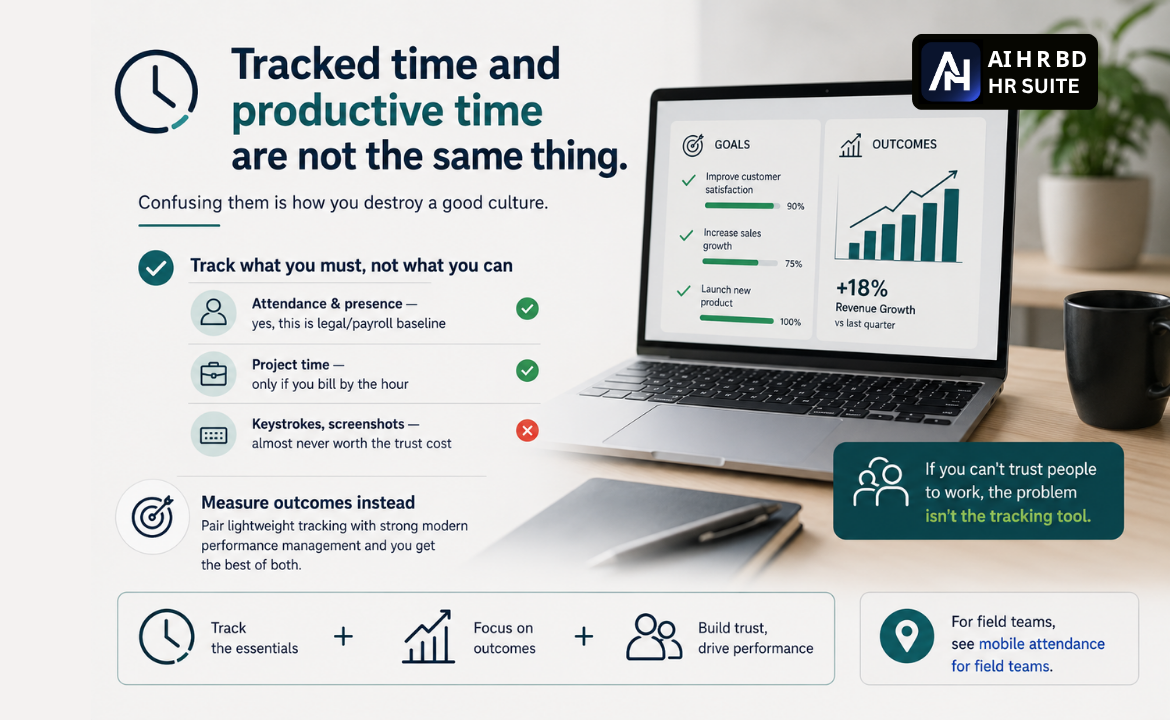
Effective time tracking is a cornerstone of efficient operations, especially in dynamic environments like Bangladesh. However, simply tracking hours doesn't automatically translate to higher productivity. Finding the sweet spot between accurate record-keeping and fostering a culture of trust is crucial for sustainable growth.
Key takeaways
- Differentiate between time worked and productive output. Confusing these can erode employee morale.
- Prioritize tracking essential data points like attendance and project hours, avoiding intrusive monitoring.
- Focus on outcomes and performance management over granular activity tracking to measure true productivity.
- Leverage modern HR technologies to streamline time tracking and integrate it with payroll and performance.
- Cultivate a culture of trust; if trust is lacking, no tracking tool will solve underlying issues.
The critical difference: Time vs. Productivity
It's a common misconception that more hours logged equals more work done. In reality, time worked refers to the duration an employee is present or available, while productivity measures the value and output generated during that time. An employee might log 8 hours but only be genuinely productive for 5, while another might achieve more in 6 focused hours.
Confusing these two can lead to counterproductive policies and a decline in employee morale. Focusing solely on time spent can inadvertently encourage "presenteeism" – where employees are physically present but not actively engaged – rather than fostering genuine output.
What to track, and what to avoid
When implementing time tracking, prioritize what you must track for legal, payroll, and project billing purposes, rather than what you can track with intrusive technologies.
Essential tracking for Bangladeshi businesses
- Attendance and Presence: This is non-negotiable for payroll, compliance with labor laws, and security. Systems like biometric scanners (ZKTeco, Hikvision) are common for employees punching in/out. For remote or field teams, mobile attendance solutions integrated with GPS can be effective.
- Project Hours: If your business bills clients by the hour (e.g., consultancies, agencies) or requires precise cost allocation for specific projects, tracking time spent on each project is vital. This helps in accurate invoicing and project profitability analysis.
What to re-evaluate or avoid
- Keystroke Logging and Screenshots: While technology allows for monitoring every keystroke or taking periodic screenshots, the cost to employee trust and morale far outweighs any perceived benefits. Such intrusive methods can lead to anxiety, micromanagement, and a focus on appearance over actual work.
- Continuous Activity Monitoring: Constantly tracking active vs. idle time on computers can create a surveillance culture. Unless there are specific, documented performance issues and clear expectations are set, this level of monitoring often backfires.
If you can't trust people to work, the problem isn't the tracking tool; it’s likely an underlying issue with hiring, management, or company culture.
Measuring outcomes as a productivity metric
Instead of relentlessly tracking every minute, shift your focus to outcomes and deliverables. This approach empowers employees, fosters accountability, and provides a clearer picture of actual productivity.
Performance management for productivity
Pair lightweight time tracking (for attendance and payroll) with robust performance management. This includes:
- Clear Goals and KPIs: Define what success looks like for each role and project. Employees should understand their individual and team objectives.
- Regular Feedback: Provide constructive feedback on progress towards goals, not just hours worked.
- Performance Reviews: Conduct structured reviews that assess contributions, achievements, and areas for development.
- Output Metrics: For sales teams, it might be sales volume; for content creators, articles published; for support, tickets resolved.
For example, a clothing factory in Bangladesh needs to track attendance for its workers to ensure payroll accuracy. However, productivity is better measured by the number of garments produced per hour per worker, or the defect rate, rather than just how long someone was on the factory floor.
Leveraging technology smartly
Modern HRM software can streamline time tracking without making it oppressive. Integrating attendance, leave management, and even project time into a single platform offers several advantages.
| Feature | Benefit for Bangladeshi Businesses |
|---|---|
| Biometric Integration | Accurate attendance for factory floors and offices, preventing "buddy punching." (e.g., ZKTeco, Hikvision) |
| Mobile Attendance (GPS-enabled) | Ideal for field staff (sales, delivery, service technicians) and remote workers. Integrates with bKash/Nagad. |
| Leave Management | Streamlines leave requests, approvals, and balances, ensuring compliance with labor laws. |
| Project Time Logging | Helps allocate costs, bill clients accurately, and understand resource utilization. |
| Payroll Integration | Automatically feeds accurate attendance data into payroll, reducing manual errors and saving time. |
When considering an HRM software for your Bangladeshi company, look for systems that offer flexibility in time tracking methods and integrate seamlessly with other HR functions.
Cultivating a culture of trust
The most effective time tracking systems operate within a culture of mutual trust and respect.
- Transparency: Clearly communicate why time is being tracked and how the data will be used. Explain that it's for payroll accuracy, project management, and fairness, not simply surveillance.
- Empowerment: Give employees ownership over their work and the ability to manage their time effectively within defined expectations.
- Fairness: Ensure policies are applied consistently across the board.
- Feedback Loops: Encourage employees to provide feedback on the time tracking process itself, and be open to adjustments.
When trust is established, employees are more likely to accurately log their time and focus on their work, knowing their contributions are valued based on output, not just presence.
Related reading
Frequently asked questions
- How can an HR manager in Bangladesh accurately track employee attendance while avoiding micromanagement?
- Bangladeshi HR managers can use biometric systems like ZKTeco for on-site staff or GPS-enabled mobile attendance solutions for remote and field teams, as these provide accurate presence data without intrusive monitoring. Focus on measuring outcomes and deliverables rather than constant activity tracking to foster trust and genuine productivity. Integrate these lightweight time tracking methods with your payroll system for efficiency.
- What is the difference between time worked and productivity for Bangladeshi businesses?
- Time worked is simply the duration an employee is present or available, essential for payroll and compliance with the Bangladesh Labour Act 2006. Productivity, however, measures the value, output, or deliverables generated during that time. A business should focus on outcomes like garments produced or tickets resolved to truly assess an employee's contribution.
- Which time tracking features in HRM software are most beneficial for a Bangladeshi company's payroll and compliance?
- For Bangladeshi companies, HRM software with biometric integration for accurate attendance, GPS-enabled mobile attendance for field staff (which can integrate with mobile banking like bKash/Nagad), and seamless payroll integration are highly beneficial. These features ensure accurate salary calculations, proper leave management, and compliance with labor regulations related to working hours.
- Should a Bangladeshi business monitor employee keystrokes or screenshots to ensure productivity?
- The article advises against monitoring keystrokes or taking screenshots. While technologically possible, these intrusive methods severely damage employee trust and morale, leading to counterproductive outcomes and presenteeism. Instead, focus on clear goals, regular feedback, and performance reviews to measure actual output and productivity effectively.