
Run this in AIHR BD instead of a spreadsheet
NBR-compliant payroll, ZKTeco & Hikvision attendance sync and bKash/Nagad salary disbursement — 14-day free trial, no credit card required.
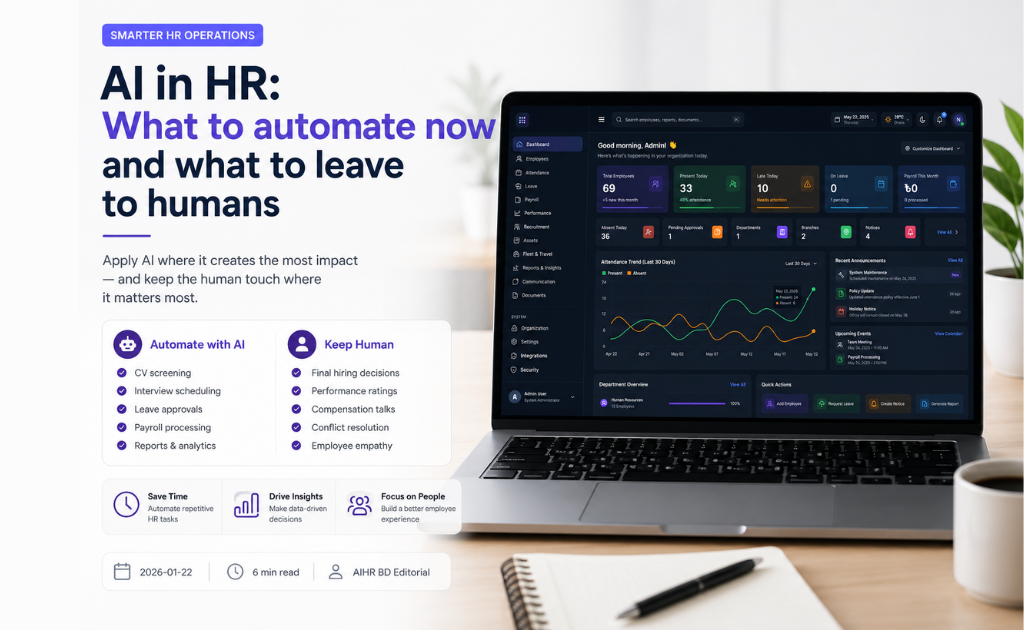
Artificial intelligence (AI) represents the most significant paradigm shift in human resources since the advent of spreadsheets. When implemented strategically, AI empowers HR teams to concentrate on valuable human interactions rather than administrative burdens. However, improper application risks dehumanising processes and harming your employer brand.
Key takeaways
- AI can effectively automate repetitive, rule-based HR tasks like CV screening and payroll processing.
- Leverage AI as a co-pilot for tasks requiring human oversight, such as drafting job descriptions or summarising performance reviews.
- Critical human interactions like final hiring decisions, performance ratings, and conflict resolution should never be fully automated.
- Vigilantly monitor AI tools for bias to ensure fair and equitable treatment of all employees and candidates.
- Adopt a phased implementation approach, starting with small, measurable automations to build confidence and refine processes.
The Strategic Imperative: Why AI in HR Matters
The HR landscape is evolving rapidly, and AI offers a transformative opportunity to enhance efficiency and effectiveness. By offloading mundane, transactional tasks to AI, HR professionals can reclaim valuable time. This allows them to focus on strategic initiatives like talent development, employee engagement, and fostering a positive work culture. The goal isn't to replace human HR, but to augment it, making it more impactful and data-driven.
AI has the potential to free up significant HR time, with estimates suggesting up to 10 hours per week for teams that integrate it wisely. This reclaimed time can be reinvested into high-value, human-centric activities.
What to Automate Confidently in HR
Certain HR functions are ripe for full or near-full automation due to their repetitive, rule-based nature. Automating these areas can yield immediate efficiency gains and cost savings.
- CV Screening: Implement AI tools to filter resumes based on keywords, experience, and other pre-defined criteria. This dramatically speeds up the initial candidate evaluation process, focusing human attention on the most qualified applicants.
- Interview Scheduling: AI-powered tools can manage the complex logistics of scheduling interviews, finding optimal times across multiple calendars, and sending automated reminders.
- Onboarding Workflows: Automate sequences of onboarding emails, document distribution, and task assignments to ensure a consistent and welcoming experience for new hires.
- Leave Approval Routing: Set up automated workflows for leave requests, directing them to the appropriate managers for approval based on company policies.
- Payroll Calculation and Processing: This is one of the most impactful areas for automation. AI-driven payroll systems can handle complex calculations involving NBR tax deductions, Provident Fund contributions, gratuity, and other allowances with precision, significantly reducing errors and manual effort. The ROI of payroll automation for Bangladeshi SMEs highlights the significant benefits experienced by businesses adopting such systems.
- Expense Receipt OCR: Use Optical Character Recognition (OCR) technology to automatically extract data from expense receipts, streamlining expense reporting and reconciliation.
- Policy Q&A Chatbots: Deploy chatbots to answer frequently asked questions about HR policies, benefits, and procedures, providing instant support to employees and reducing HR team workload.
Using AI as an HR Co-Pilot
For tasks requiring creativity, nuance, or a human touch, AI shines as a "co-pilot." In these scenarios, AI generates drafts or suggestions, which human HR professionals then review, refine, and finalise.
- Drafting Job Descriptions: AI can generate initial job descriptions based on role requirements, saving time in the initial drafting phase.
- Summarising Performance Reviews: AI algorithms can condense lengthy performance review documents into concise summaries, highlighting key strengths, areas for improvement, and goal progress.
- Suggesting Interview Questions: AI can propose relevant and probing interview questions tailored to specific roles and competencies.
- Generating Training Content Outlines: AI can help structure training materials and course outlines, providing a foundation for L&D teams to build upon.
- Translating HR Policies: For multinational or diverse workforces in Bangladesh, AI can quickly translate complex HR policies into Bangla or other local languages, ensuring clarity and accessibility.
Non-Negotiables: What HR Must NOT Automate
While AI is powerful, certain HR functions are inherently human-centric and should never be fully automated. These moments often involve empathy, ethical judgment, and complex interpersonal dynamics.
- Final Hiring Decisions: While AI can screen and recommend, the ultimate decision to hire someone involves assessing cultural fit, soft skills, and intangible qualities that only human judgment can truly evaluate.
- Performance Ratings and Feedback: Providing constructive performance feedback and assigning ratings requires human understanding of context, individual circumstances, and potential.
- Compensation Conversations: Discussions about salary, bonuses, and benefits deeply impact an employee's livelihood and motivation. These conversations demand empathy, discretion, and a human touch.
- Conflict Resolution: Mediating disputes and resolving workplace conflicts requires emotional intelligence, active listening, and impartial judgment that AI cannot replicate.
- Termination Decisions: Ending an employment relationship is a highly sensitive process that requires compassion, legal adherence, and direct human involvement.
Addressing AI Bias and Ethical Considerations
AI systems learn from the data they are fed. If this data contains historical biases, the AI will perpetuate and even amplify those biases. This is a critical concern, especially in sensitive areas like recruitment.
- Bias in Recruitment: An AI screening tool trained on past hiring data might inadvertently discriminate against women, certain universities, or older candidates if historical hiring practices showed such patterns. It's crucial to understand the evolving landscape of AI in HR to manage these risks.
- Regular Audits: Conduct quarterly audits of your AI tools, especially those used in recruitment, to ensure they are not unfairly filtering out qualified candidates based on protected characteristics.
- Diverse Data Sets: Strive to train AI models on diverse and representative datasets to minimise inherent biases.
- Human Oversight: Always maintain human oversight and the ability to override AI decisions, particularly in fairness-critical applications.
A Phased Approach to AI Implementation
Don't attempt a massive, company-wide AI overhaul from day one. A strategic, phased approach is far more effective.
- Identify a Key Workflow: Select one specific, high-volume, repetitive HR workflow that could significantly benefit from automation (e.g., interview scheduling, the initial phase of CV sorting).
- Implement and Measure: Introduce an AI tool for this workflow. Carefully measure the time saved, reduction in errors, and overall efficiency improvements.
- Gather Feedback: Collect feedback from the HR team and employees interacting with the new system.
- Refine and Expand: Based on results and feedback, refine the process and then gradually expand to other suitable workflows. This builds confidence and allows the team to adapt organically.
Starting small allows your organisation to learn, adapt, and build trust in AI, ensuring a smoother and more successful integration into your HR operations.
Related reading
Frequently asked questions
- Which HR tasks should Bangladeshi companies automate first with AI to see quick benefits?
- For Bangladeshi companies, prioritise automation of repetitive, rule-based tasks such as CV screening, interview scheduling, onboarding workflows, leave approval routing, and particularly payroll calculation and processing. Automating payroll is highly impactful as it handles complex calculations involving NBR tax deductions, Provident Fund, and gratuity accurately, reducing manual errors significantly. These areas offer immediate efficiency gains and cost savings.
- Can AI-driven payroll systems handle NBR tax and Provident Fund calculations accurately for Bangladesh employees?
- Yes, AI-driven payroll systems are designed to accurately handle complex calculations specific to Bangladesh, including NBR tax deductions, Provident Fund contributions, and gratuity. By automating these processes, businesses can significantly reduce errors and manual effort, ensuring compliance with local regulations. This frees up HR teams to focus on more strategic initiatives.
- What HR functions should not be automated by AI in a Bangladeshi business context?
- Certain HR functions should never be fully automated, as they require human empathy, judgment, and ethical considerations. These include final hiring decisions, providing performance ratings and feedback, sensitive compensation conversations, conflict resolution, and termination decisions. These critical interactions demand a human touch to ensure fairness, legal adherence, and a positive employer-employee relationship.
- How can AI help with HR policy communication for a diverse workforce in Bangladesh?
- AI can act as a valuable co-pilot for HR policy communication. It can help translate complex HR policies into Bangla or other local languages, ensuring clarity and accessibility for all employees. Additionally, AI-powered chatbots can provide instant answers to frequently asked questions about policies, reducing the HR team's workload and improving employee self-service.