
Run this in AIHR BD instead of a spreadsheet
NBR-compliant payroll, ZKTeco & Hikvision attendance sync and bKash/Nagad salary disbursement — 14-day free trial, no credit card required.
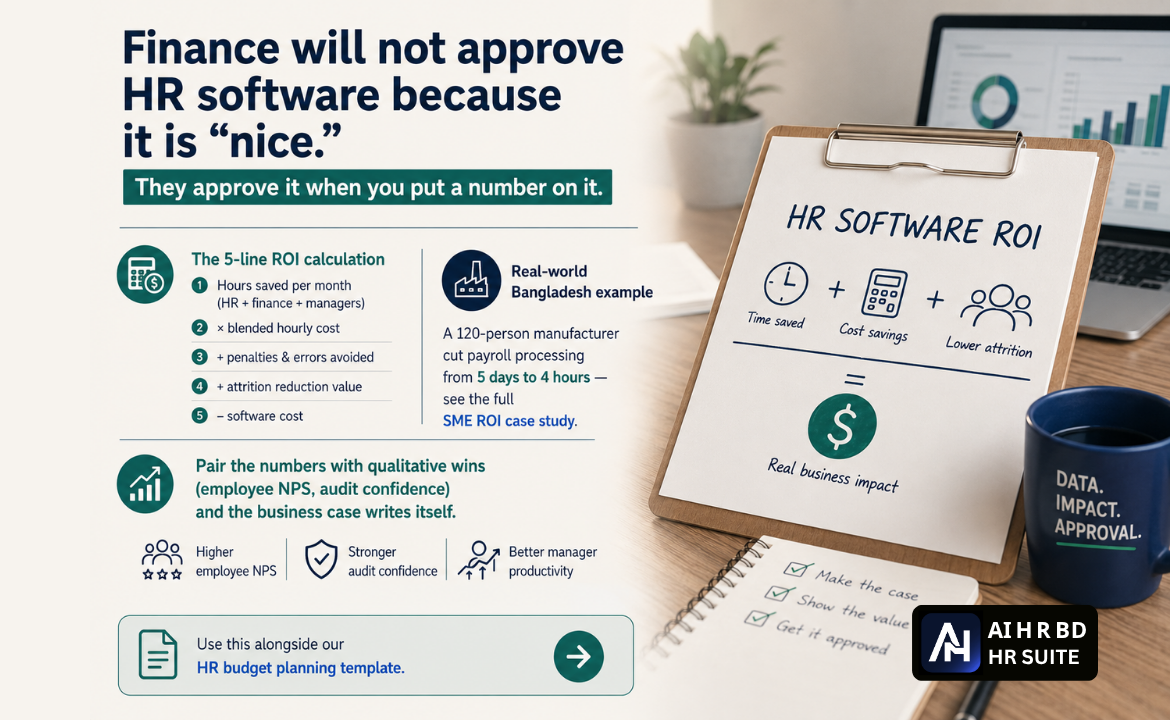
Investing in HR software is a strategic decision that demands a clear understanding of its financial returns. To secure executive buy-in, especially from the CFO, HR professionals must articulate the tangible benefits in monetary terms, demonstrating a compelling return on investment (ROI). This guide provides a practical framework, complete with a Bangladesh-specific example, to help you calculate and present the ROI of your HR software investments.
Key takeaways
- HR software ROI moves beyond qualitative benefits, focusing on measurable financial gains.
- The core ROI calculation quantifies time savings, error avoidance, attrition reduction, and then subtracts software costs.
- Tangible benefits like reduced processing time and improved compliance are crucial for a strong business case.
- A practical example illustrates how payroll automation can deliver substantial ROI for Bangladeshi SMEs.
- Complementing financial figures with qualitative wins strengthens your overall proposal.
Why measure HR software ROI?
HR software, while offering numerous operational advantages, represents a significant financial outlay. To justify this investment and gain approval from finance stakeholders, HR leaders must present a robust business case rooted in financial metrics. Simply stating that a solution will "improve efficiency" or "boost employee morale" is rarely sufficient. Instead, you need to quantify the monetary value it brings to the organization.
Measuring ROI transforms a discretionary expense into a strategic investment, allowing you to demonstrate how HR directly contributes to the company's bottom line. This approach aligns HR initiatives with broader business objectives, fostering better collaboration with finance and securing the resources needed for impactful HR programs.
The 5-line ROI calculation for HR software
Measuring the ROI of HR software doesn't have to be overly complex. We can break it down into a straightforward, five-step calculation that your CFO will understand and appreciate.
ROI Formula Simplified: (Total Benefits - Software Cost) / Software Cost * 100%
Here’s a practical, line-by-line approach to calculating the financial return:
- Hours saved per month (HR + Finance + Managers): Identify all personnel who will save time due to the new software. This includes HR staff, payroll processors, finance department members, and even line managers who spend time on tasks like approving leave or managing performance reviews.
- × Blended hourly cost: Multiply the total hours saved by a blended hourly cost. This cost should include not just salary, but also benefits, taxes, and overhead associated with each employee. This gives you the direct monetary value of time saved.
- + Penalties & errors avoided: Quantify the financial impact of reducing errors. For instance, less manual data entry means fewer payroll errors, reducing the cost of corrections and potential fines from the NBR or Department of Labour. Better compliance features can prevent costly penalties.
- + Attrition reduction value: Estimate the cost of employee turnover that the software might mitigate. HR software can improve employee experience, streamline onboarding, and provide better insights into employee engagement, which can lead to reduced attrition. The cost of replacing an employee in Bangladesh can be several months' salary.
- − Software cost: Subtract the total cost of the software, including implementation fees, annual subscriptions, training, and ongoing maintenance.
Example blended hourly cost calculation
| Employee Type | Monthly Salary (BDT) | Benefits & Overhead Factor | True Monthly Cost | Hours/Month | Blended Hourly Cost (BDT) |
|---|---|---|---|---|---|
| HR Executive | ৳40,000 | 1.35 | ৳54,000 | 160 | ৳337.50 |
| Finance Officer | ৳50,000 | 1.35 | ৳67,500 | 160 | ৳421.88 |
| Line Manager | ৳70,000 | 1.35 | ৳94,500 | 160 | ৳590.63 |
(A factor of 1.35 is used here for benefits and overhead as an example; actual factor can vary.)
Real-world Bangladesh example: Payroll automation ROI
Consider a 120-person manufacturing company in Bangladesh. They traditionally spend significant time on manual payroll processing. Implementing an automated payroll software dramatically reduces this workload.
- Before Software: Payroll processing took 5 days for 2 HR staff and 1 Finance staff.
- After Software: Payroll processing reduced to 4 hours for 1 HR staff.
Let's use conservative blended hourly costs: HR staff at ৳350/hour, Finance staff at ৳450/hour.
Calculation of ROI
-
Time Savings Calculation:
- Before: (2 HR staff * 5 days * 8 hours/day) + (1 Finance staff * 5 days * 8 hours/day) = (80 hours HR) + (40 hours Finance) = 120 hours
- After: (1 HR staff * 4 hours) = 4 hours
- Hours Saved: 120 hours - 4 hours = 116 hours per month
-
Monetary Value of Hours Saved:
- (80 hours HR * ৳350/hour) + (40 hours Finance * ৳450/hour) = ৳28,000 + ৳18,000 = ৳46,000/month (before software)
- (4 hours HR * ৳350/hour) = ৳1,400/month (after software)
- Direct Savings: ৳46,000 - ৳1,400 = ৳44,600 per month
-
Penalties & Errors Avoided:
- Assume 2-3 significant payroll errors per month, each costing ৳500-৳1,000 in correction time and employee dissatisfaction. Plus, potential for NBR non-compliance fines. Let's conservatively estimate ৳5,000/month in avoided costs.
-
Attrition Reduction Value:
- Improved payroll accuracy and timeliness can boost employee morale, potentially reducing turnover. If the software helps retain just one employee per year (cost of replacement: ৳50,000), that's ~৳4,167/month in value.
-
Total Monthly Benefits: ৳44,600 (time saved) + ৳5,000 (errors avoided) + ৳4,167 (attrition) = ৳53,767
-
Software Cost:
- A monthly subscription for a 120-person company might range from ৳15,000 to ৳25,000, including support. Let's use ৳20,000.
-
Net Monthly Gain: ৳53,767 - ৳20,000 = ৳33,767
-
Annual ROI: (৳33,767 * 12 months) / (৳20,000 * 12 months) * 100% = ৳405,204 / ৳240,000 * 100% = 168.8% annual ROI
This simplified example demonstrates how the ROI of payroll automation for Bangladeshi SMEs can be substantial. Coupling these compelling figures with qualitative benefits, such as enhanced employee trust, better audit preparedness, and freeing up HR to focus on strategic initiatives, creates an undeniable business case.
Beyond the numbers: Qualitative benefits
While financial calculations are paramount, don't overlook the qualitative benefits that buttress your business case. These factors, though harder to quantify directly, significantly impact organizational health and long-term success.
- Improved Employee Experience: Streamlined processes (e.g., leave requests, payslip access via bKash/Nagad integrations, faster query resolution) enhance employee satisfaction, which indirectly affects retention and productivity.
- Enhanced Compliance & Reduced Risk: Modern HR software helps maintain NBR tax compliance, properly manage Provident Fund contributions, and ensure adherence to labor laws, safeguarding the company from legal repercussions and financial penalties.
- Better Data & Analytics: Access to robust HR data enables more informed decision-making regarding workforce planning, talent development, and identifying trends (e.g., absenteeism patterns).
- Strategic HR Focus: By automating repetitive administrative tasks, HR professionals can shift their focus from transactional activities to strategic initiatives like talent development, employee engagement, and organizational development.
- Audit Readiness: Automated systems provide clear audit trails and accurate records, simplifying internal and external audits.
Presenting your case to the CFO
When presenting your ROI analysis to the CFO or other senior stakeholders, adopt language that resonates with finance.
- Focus on business value: Translate HR benefits into financial impacts. Instead of "better performance management," discuss "reduced costs associated with underperforming employees."
- Be conservative with estimates: Always err on the side of caution when estimating savings and benefits. Overly optimistic projections can undermine your credibility.
- Highlight risk mitigation: Emphasize how the software reduces financial and compliance risks (e.g., NBR fines, labor disputes).
- Use clear, concise figures: Present the ROI calculation clearly, perhaps even using a table or simple chart.
- Contextualize with qualitative benefits: Briefly mention the strategic and operational improvements that complement the financial gains.
Consider using a structured approach like integrating these ROI calculations into a larger, more comprehensive budget proposal using our HR budget planning template. This demonstrates foresight and a holistic understanding of financial planning.
Related reading
- HR budget planning for 2026: A CFO-friendly template for Bangladesh
- The ROI of payroll automation for Bangladeshi SMEs
- Salary Sheet Format for Bangladesh: A Practical Template (BDT)
For a broader view of what to look for, read our overview of HR software in Bangladesh, including deployment options, Bangla support and local payment integrations.
Frequently asked questions
- How can I calculate the return on HR software for my Bangladeshi company?
- Quantify time saved by HR, finance, and managers and multiply it by their blended hourly cost. Add the value of avoided penalties such as NBR fines and the gain from reduced attrition, subtract total software cost including implementation and training, then divide by that cost to get a percentage.
- What is a blended hourly cost and how do I calculate it in Bangladesh?
- A blended hourly cost includes salary plus an estimated factor for benefits, taxes, and overhead, divided by monthly working hours. For example, a 40,000 taka monthly salary with a 1.35 overhead factor is 54,000 taka; divided by 160 hours that is 337.50 taka per hour.
- How does HR software reduce NBR penalties or compliance risk in Bangladesh?
- Automating payroll calculations ensures accurate tax deductions and provident fund contributions and generates compliance reports. This minimises the manual errors that often trigger discrepancies and fines, and improves adherence to Bangladesh Labour Act 2006 requirements.
- Can automating payroll really save money for a small business in Bangladesh?
- Yes. It sharply reduces the hours HR and finance spend on manual processing, which can be redirected to strategic work. It also minimises costly payroll errors, simplifies bKash and Nagad reconciliation, and helps avoid regulatory penalties.