
Run this in AIHR BD instead of a spreadsheet
NBR-compliant payroll, ZKTeco & Hikvision attendance sync and bKash/Nagad salary disbursement — 14-day free trial, no credit card required.
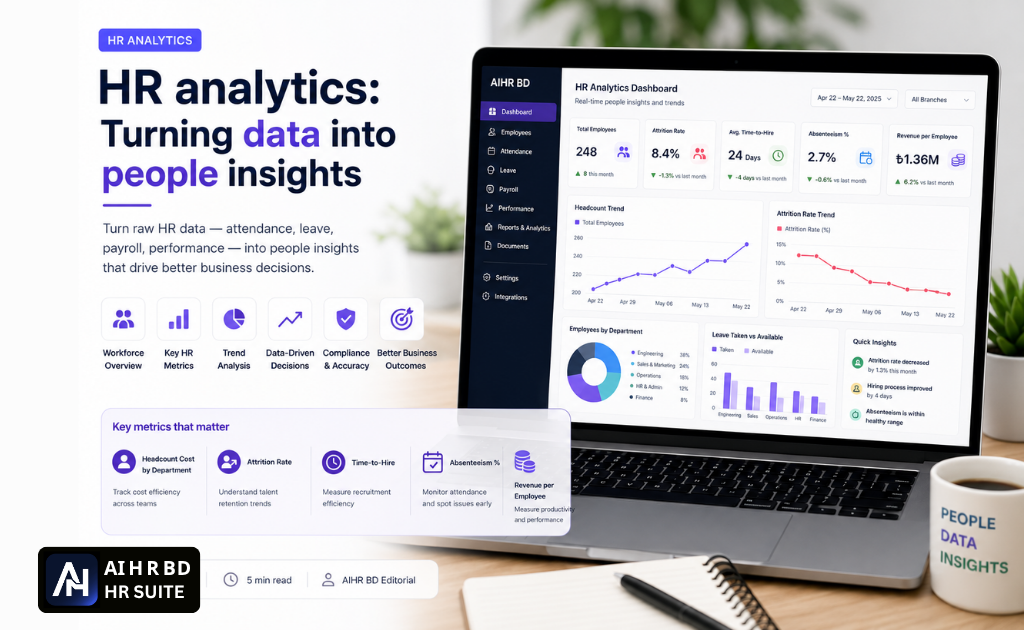
HR Analytics in Bangladesh: Turning Employee Data into Better Business Decisions
HR departments in Bangladesh collect vast amounts of employee data daily, from attendance and leave to payroll and performance. While this data holds immense potential, it often remains underutilized. HR analytics transforms raw HR data into actionable insights, empowering businesses to make informed decisions that drive growth and efficiency.
Key takeaways
HR analytics extracts strategic insights from HR data, moving beyond basic reporting.
Key metrics like headcount cost, attrition, and time-to-hire directly inform business decisions.
Effective analytics requires defining owners, thresholds, and response plans for each metric.
Leveraging HR analytics helps identify trends, predict future challenges, and optimize HR strategies.
Integrated HRM software is crucial for collecting, organizing, and analyzing HR data efficiently.
What is HR analytics?
HR analytics is the process of collecting, analyzing, and interpreting human resource data to enhance business outcomes. Unlike traditional HR reporting, which focuses on what happened, HR analytics delves deeper into why it happened and what will happen next. This strategic approach helps organizations understand the impact of HR initiatives on overall business performance.
For instance, instead of just reporting the number of employees who left, HR analytics examines factors like department, tenure, performance, and compensation to uncover the root causes of attrition and turnover. This deeper understanding allows companies to implement targeted retention strategies, saving significant costs associated with recruitment and training.
Why HR analytics matters in Bangladesh
In Bangladesh's dynamic business environment, optimizing human capital is paramount for competitive advantage. HR analytics provides the data-driven clarity needed to:
Improve workforce efficiency: Identify bottlenecks, optimize staffing levels, and enhance productivity.
Reduce operational costs: Pinpoint areas of excessive spending related to recruitment, overtime, or benefits.
Enhance employee experience: Understand factors influencing employee satisfaction, engagement, and retention.
Support strategic planning: Provide insights for talent acquisition, succession planning, and organizational development.
Ensure compliance: Monitor metrics related to NBR tax, Provident Fund, and gratuity calculations, ensuring accuracy and adherence to regulations.
Key HR metrics for business impact
While the scope of HR metrics is vast, certain data points consistently provide critical insights for CEOs and business leaders. Focusing on these metrics can quickly demonstrate the value of HR analytics:
Headcount cost by department/branch: Understand expenditure per employee across different organizational units.
Attrition rate (voluntary vs. involuntary): Differentiate between employees leaving by choice and those terminated, revealing potential issues with culture or performance management.
Time-to-hire by role: Measure the efficiency of the recruitment process, impacting productivity and cost.
Absenteeism percentage trend: Track unauthorized absences over time to identify underlying causes, such as poor morale or health issues.
Revenue per employee: A crucial productivity metric showing how much revenue each employee generates.
A comprehensive list of essential metrics can be found in our guide on "10 HR analytics metrics every CEO should track in 2026."
From dashboard to decision: Actionable insights
Presenting data in a dashboard is only the first step. True value comes from transforming those insights into concrete actions. To move from passive reporting to active decision-making, every metric needs:
An owner: A specific individual or team responsible for monitoring the metric and acting on its findings.
A threshold: Clearly defined acceptable ranges or trigger points. For example, "if voluntary attrition exceeds 10% for a quarter."
A response playbook: Pre-defined steps or actions to take when a threshold is met or exceeded.
Consider the following example:
MetricOwnerThresholdResponse PlaybookTime-to-HireTalent Acquisition LeadIf > 30 days for critical roles1. Review job description & salary benchmarking.2. Evaluate sourcing channels.3. Optimize interview process for efficiency.Absenteeism %Department ManagerIf > 5% for an individual or > 3% for a team1. Conduct individual check-in.2. Identify recurring patterns.3. Offer support (e.g., flexible work, health resources).Voluntary AttritionHR Business PartnerIf > 10% quarterly in any department1. Conduct exit interviews.2. Analyze common feedback.3. Propose retention strategies.
Without these three components, even the most sophisticated dashboards are just decorative.
Leveraging technology for HR analytics
The foundation of effective HR analytics is robust data collection and management. An integrated Human Resource Management (HRM) software is essential for Bangladeshi companies looking to streamline HR processes and generate valuable insights.
An HRM system can:
Centralize data: Consolidate attendance (from ZKTeco/Hikvision devices), leave, payroll, performance reviews, and employee demographics into a single database.
Automate reporting: Generate custom reports and dashboards with real-time data.
Simplify payroll: Manage salaries, NBR tax, provident fund, and gratuity calculations accurately for timely disbursement via bank transfers or mobile money services like bKash/Nagad.
Track performance: Monitor KPIs and provide data for performance appraisals.
Support compliance: Maintain records and generate reports for regulatory requirements.
Modern HRM software for Bangladesh often includes built-in analytics capabilities, allowing HR professionals to identify trends, predict future challenges, and optimize multi-branch HR management.
Investing in the right HRM software is a strategic step towards data-driven HR.
The future of HR analytics
The field of HR analytics is rapidly evolving, with artificial intelligence (AI) and machine learning playing an increasingly significant role. Predictive analytics, for example, can forecast future trends like turnover risk, talent shortages, or the impact of new policies. This allows HR to proactively address challenges rather than reactively responding to them.
As organizations in Bangladesh embrace digital transformation, the strategic importance of HR analytics will only grow. It is no longer just about optimizing HR functions but about enabling the entire business to make better decisions fueled by people insights.
These advancements align with broader trends shaping the future of work, making HR a central driver of organizational success.
Related reading
10 HR analytics metrics every CEO should track in 2026
AI in HR: Top Trends Shaping the Future of Work in 2026
HRM Software in 2026: A Buyer's Guide for Bangladeshi Companies
Related reading
Frequently asked questions
- What is HR analytics and how does it benefit my business in Bangladesh?
- HR analytics is the process of collecting, analysing, and interpreting HR data to gain actionable insights beyond basic reporting. For Bangladeshi businesses it improves workforce efficiency, reduces operational cost, raises employee satisfaction, and supports compliance with NBR tax rules.
- What key HR metrics should a Bangladeshi CEO track?
- Track headcount cost per department for budget control, attrition split into voluntary and involuntary, and time-to-hire by role for recruitment efficiency. Absenteeism trends and revenue per employee add crucial insight into productivity and operational health.
- How can HR analytics help ensure compliance with the Labour Act and tax regulations?
- Analytics can monitor metrics tied to NBR tax, Provident Fund, and gratuity calculations, ensuring accuracy against the Labour Act 2006 and other local rules. Analysing payroll and benefit data helps identify discrepancies before they become penalties.
- What technology is essential for implementing HR analytics in Bangladesh?
- An integrated HRM system is the foundation. It centralises attendance from devices such as ZKTeco or Hikvision along with leave, payroll, and performance data, giving you one reliable base for analysis instead of scattered spreadsheets.