
Run this in AIHR BD instead of a spreadsheet
NBR-compliant payroll, ZKTeco & Hikvision attendance sync and bKash/Nagad salary disbursement — 14-day free trial, no credit card required.
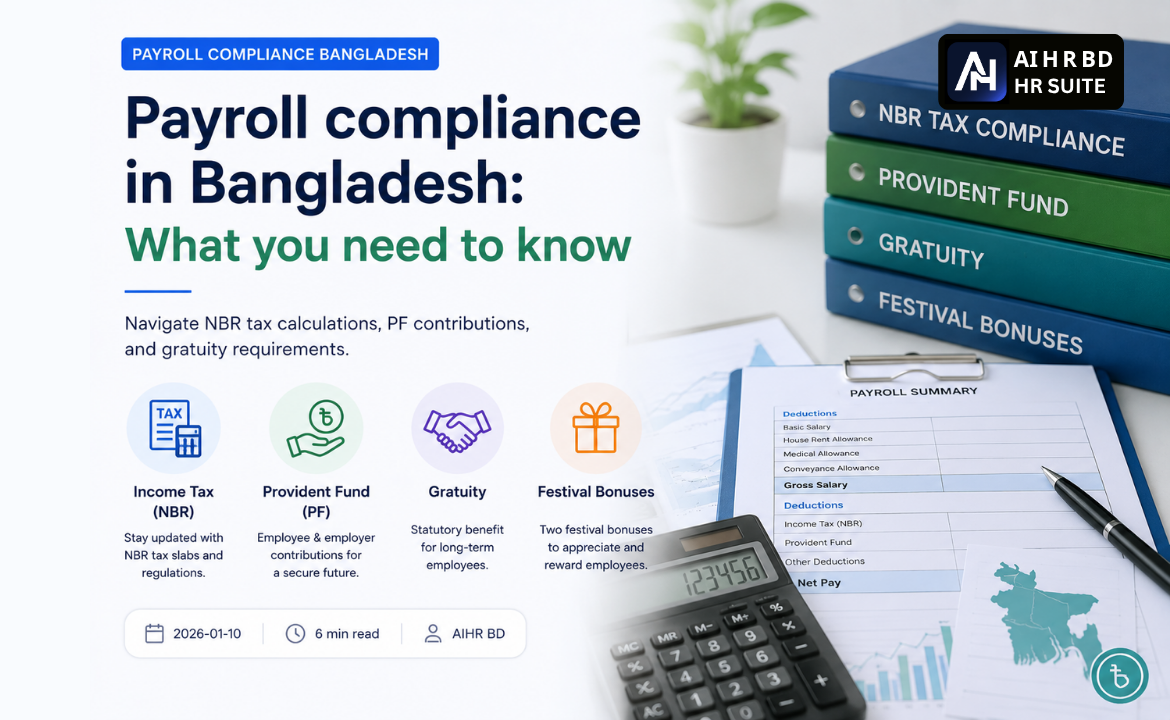
Ensuring payroll compliance in Bangladesh is critical for any business. Mistakes can lead to significant financial penalties from the National Board of Revenue (NBR), costly arrears for Provident Fund contributions, and legal issues stemming from incorrect gratuity payments. Understanding and adhering to the regulatory framework is essential to avoid these pitfalls and maintain a smooth operation.
If you are evaluating platforms, see our guide to HR software built for Bangladesh — it covers local compliance, BDT pricing and bKash/Nagad payroll in one place.
Key takeaways
- Payroll in Bangladesh is governed by four core pillars: income tax, Provident Fund, gratuity, and festival bonuses.
- Annual updates to the Finance Act mean tax slabs and rules change yearly, requiring constant vigilance.
- Accurate calculation of Provident Fund and gratuity is crucial, based on specific rules for qualifying periods and salary components.
- Digital tools, including HR/payroll software and mobile banking for disbursements, significantly enhance compliance and efficiency.
The Pillars of Payroll Compliance
Navigating payroll in Bangladesh requires a clear understanding of its foundational components. Compliance rests on these four key areas, each with specific regulations and calculation methodologies.
- Income Tax (NBR): Every employee is subject to income tax based on their annual earnings, as stipulated by the National Board of Revenue (NBR). Taxable income is calculated after deducting allowable exemptions and investments. Tax slabs are updated annually via the Finance Act.
- Provident Fund (PF): A mandatory or voluntary savings scheme, the Provident Fund typically involves contributions from both the employee and employer. While the Labour Act 2006 doesn't mandate a PF for all companies, most established businesses implement it. Contributions usually range from 7% to 10% of the employee's basic salary, with the employer matching the employee's contribution.
- Gratuity: Eligible employees are entitled to gratuity payments upon termination, resignation, or retirement, provided they meet specific service period criteria. The standard calculation is 30 days' basic salary for each completed year of service, often after a qualifying period of at least five years, as outlined in the Bangladesh Labour Act compliance: Essential guide for employers.
- Festival Bonuses: In Bangladesh, it's customary to provide two festival bonuses annually to permanent employees, typically before Eid-ul-Fitr and Eid-ul-Adha. These are usually equivalent to one month's basic salary each.
NBR Income Tax: Staying Current
Income tax calculation is perhaps the most dynamic aspect of payroll. The NBR revises tax slabs, exemption limits, and investment rebate rules every year through the annual Finance Act.
Crucial reminder: Failing to update your payroll system with the latest NBR regulations can lead to incorrect tax deductions, resulting in penalties for the employer and potential issues for employees during their tax assessment.
Employers must ensure their payroll system correctly accounts for:
- Income tax slabs: Progressive rates applied to different income brackets.
- Tax-free thresholds: The portion of income that is not subject to tax.
- Investment rebates: Reductions in tax liability for specified investments (e.g., life insurance, approved savings schemes).
- Allowable exemptions: Specific allowances like house rent, medical, and conveyance that are exempt up to certain limits.
For a practical look at how these elements come together, refer to our guide on Salary Sheet Format for Bangladesh: A Practical Template (BDT).
Provident Fund and Gratuity: Accuracy is Key
Miscalculations in Provident Fund and gratuity are common audit findings.
Provident Fund (PF) Nuances
The primary area of confusion in PF calculations often revolves around the base salary.
- Basic vs. Gross: PF contributions are almost always calculated based on the employee's basic salary, not the gross salary. Ensure your payroll system clearly distinguishes these components.
- Eligibility: Confirm eligibility criteria for employees (e.g., probation completion) before initiating contributions.
- Remittance: Ensure timely and accurate remittance of both employee and employer contributions to the designated PF trust or fund.
Gratuity Calculation
Gratuity is a statutory right for eligible employees. Key aspects include:
- Service Period: Employees typically need to complete a minimum tenure (e.g., 5 years) to be eligible. The calculation is based on completed years of service.
- Last Drawn Basic Salary: The gratuity amount is usually calculated based on the employee's last drawn basic salary, multiplied by the number of completed service years and a specific factor (e.g., 30 days' salary).
- Company Policy: While the Labour Act provides a baseline, companies can offer more generous gratuity schemes. Ensure your policy is clear and consistently applied.
Payroll Records and Payslips
Maintaining meticulous records is not just good practice; it's a legal requirement.
- Employee Data: Complete and updated records for all employees, including their appointment letters, joining dates, salary structures, leave records, and tax declarations.
- Payslips: Provide clear, detailed payslips to all employees, showing gross salary, deductions (tax, PF), and net pay. These should be available monthly.
- Terminated Employees: Special attention is needed for terminated employees. Ensure all final settlements, including outstanding salary, leave encashment, PF, and gratuity, are calculated correctly and paid promptly. Payslips and settlement statements for terminated employees must also be accurately generated and provided. Missing these documents can lead to disputes.
Leveraging Technology for Compliance
Manual payroll processing is prone to human error and becomes increasingly complex with regulatory changes. Embracing technology can significantly enhance compliance and efficiency.
- HRM Software: Modern HRM software designed for the Bangladeshi context automatically updates with the latest NBR tax slabs, PF rules, and gratuity calculations. This minimizes manual intervention and reduces the risk of errors. Features like automated payslip generation and compliance reports are invaluable. Learn more about choosing the right system in HRM Software in 2026: A Buyer's Guide for Bangladeshi Companies.
- Digital Disbursements: Integrating with mobile banking platforms like bKash or Nagad for salary disbursement ensures timely, traceable payments, reducing cash handling risks and administrative burden.
- Time & Attendance: Integrating systems like ZKTeco or Hikvision for time and attendance ensures accurate working hour data, which directly impacts attendance-based pay and leave calculations.
By investing in robust systems and staying informed about regulatory changes, Bangladeshi businesses can transform payroll from a compliance burden into a streamlined, accurate process.
Related reading
Frequently asked questions
- What are the main components of payroll compliance in Bangladesh according to NBR and the Labour Act?
- Payroll compliance in Bangladesh primarily revolves around four pillars: income tax as per NBR regulations, Provident Fund contributions, gratuity payments, and festival bonuses. These are governed by the annual Finance Act for tax and the Labour Act 2006 for other components.
- How is Provident Fund calculated in Bangladesh and is it mandatory for all companies?
- Provident Fund contributions in Bangladesh are typically calculated on basic salary, not gross, often ranging from 7% to 10% from both employee and employer. While the Labour Act 2006 does not mandate PF for every company, most established businesses implement it. Eligibility usually depends on completion of probation and company policy.
- What is the typical eligibility and calculation for gratuity payments under Bangladesh labour law?
- Employees are generally eligible for gratuity after completing a minimum service period, often five years. The amount is typically calculated as 30 days last drawn basic salary for each completed year of service, paid on termination, resignation, or retirement. Companies may offer more generous schemes than the statutory baseline.
- How often do NBR income tax rules change for payroll in Bangladesh, and what is the impact?
- NBR income tax rules, including slabs, exemption limits, and investment rebates, are updated annually through the Finance Act. Businesses must update their payroll systems each year to reflect these changes and avoid incorrect deductions, which can lead to penalties for the employer and problems for employees at assessment time.